

How Stellantis Achieved 35% Downtime Reduction Through Advanced Anomaly Detection Manufacturing
In today’s competitive manufacturing landscape, unplanned downtime costs the global manufacturing industry over £40 billion annually. For automotive giant Stellantis, this challenge was particularly acute across their European production facilities, where even minor equipment anomalies could cascade into significant production losses.
This comprehensive case study examines how Stellantis implemented JEMBA’s no-code industrial AI platform to establish robust anomaly detection manufacturing capabilities across their operations, resulting in measurable improvements in equipment reliability, quality control, and operational efficiency.
The Manufacturing Challenge: Hidden Anomalies Driving Costs
Stellantis faced a complex web of manufacturing challenges across their facilities. Traditional monitoring systems were reactive rather than predictive, often detecting issues only after they had already impacted production. The company needed a solution that could identify subtle anomalies before they escalated into costly failures.
Key Pain Points Identified
The manufacturing team at Stellantis identified several critical areas where anomaly detection could provide immediate value:
- Equipment Performance Degradation: Gradual wear patterns were difficult to detect until catastrophic failure occurred
- Quality Variations: Subtle process deviations affecting product quality were often discovered too late in the production cycle
- Energy Consumption Anomalies: Unexpected spikes in energy usage indicated equipment inefficiencies
- Environmental Condition Fluctuations: Temperature, humidity, and pressure variations impacting production quality
JEMBA Implementation: 48-Hour Setup to Production
The implementation of JEMBA’s anomaly detection manufacturing platform began with a pilot programme at Stellantis’s main assembly facility. The no-code approach meant that plant engineers could configure and deploy the system without extensive programming knowledge.
Phase 1: Data Integration and Baseline Establishment
JEMBA’s platform connected seamlessly to Stellantis’s existing infrastructure through OPC UA protocols, eliminating the need for costly PLC modifications. Within the first 24 hours, the system was ingesting data from over 200 sensors across critical production lines.
The auto-training models began establishing baseline patterns for normal operations, learning the unique characteristics of each piece of equipment. This included:
- Vibration patterns from rotating machinery
- Temperature profiles of heating elements
- Pressure variations in hydraulic systems
- Power consumption signatures of motors and drives
Phase 2: Anomaly Detection Model Deployment
By hour 48, JEMBA’s machine learning algorithms had processed sufficient historical data to begin real-time anomaly detection. The system deployed multiple detection methodologies:
Statistical Process Control: Identifying when process parameters exceeded statistical control limits based on historical performance data.
Machine Learning Classification: Using ensemble methods to classify normal versus anomalous behaviour patterns across multiple sensor inputs simultaneously.
Time Series Analysis: Detecting temporal anomalies that might indicate gradual equipment degradation or cyclical issues.
Real-World Results: Quantifiable Impact Across Operations
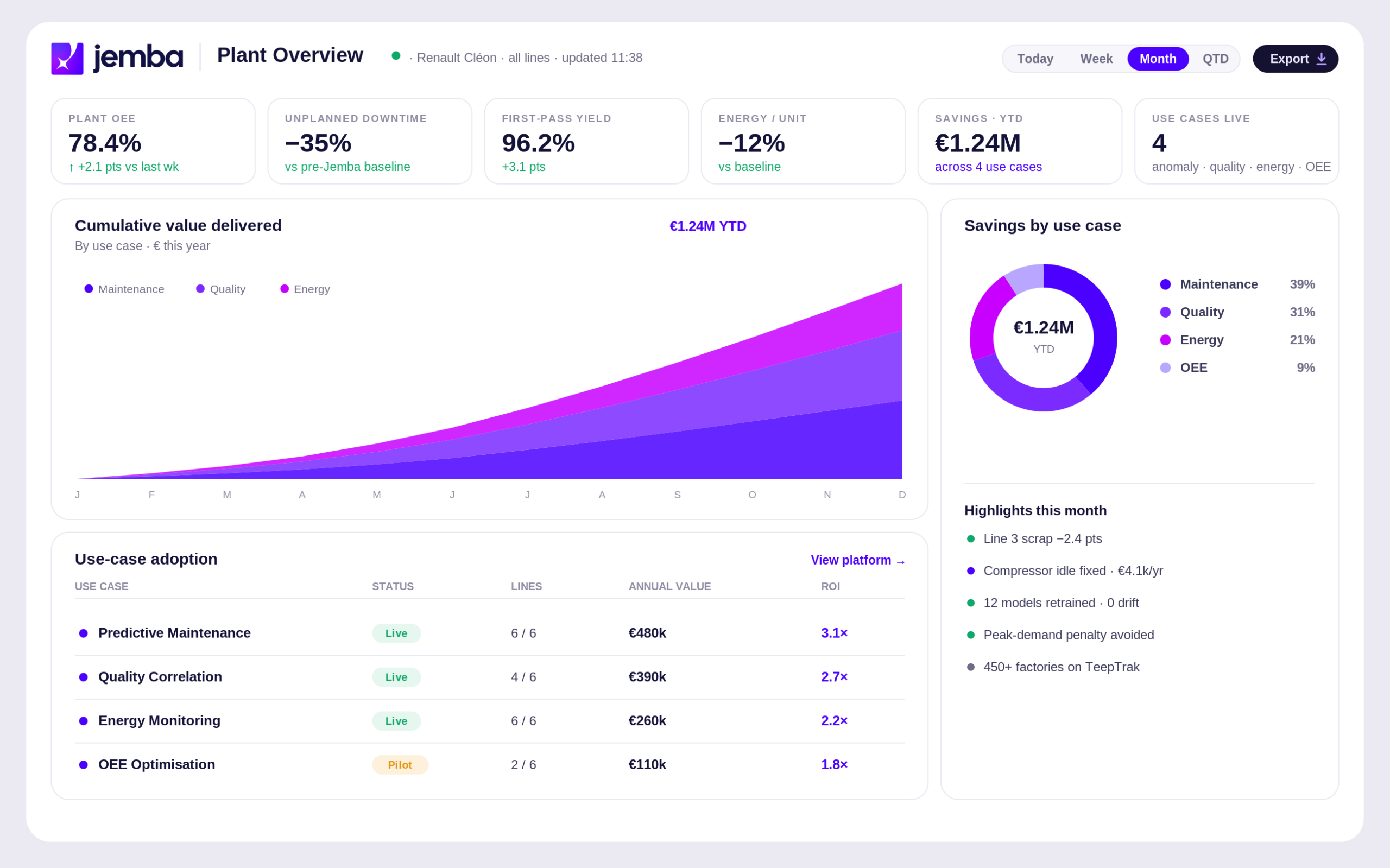
The implementation of anomaly detection manufacturing capabilities delivered measurable results within the first quarter of deployment. Stellantis documented significant improvements across multiple key performance indicators.
Downtime Reduction: 35% Improvement
The most significant impact was the reduction in unplanned downtime. JEMBA’s early warning system enabled maintenance teams to address potential issues during scheduled maintenance windows rather than responding to emergency failures.
Specific examples included:
- A conveyor motor showing gradual bearing wear was identified 72 hours before failure, allowing for planned replacement during a weekend shutdown
- Hydraulic pressure anomalies in a stamping press were detected, preventing a catastrophic failure that would have required a week-long production halt
- Paint booth temperature variations were identified and corrected, preventing quality issues that would have required extensive rework
Quality Improvements: 28% Reduction in Defects
The anomaly detection system proved equally effective at identifying process variations that impacted product quality. By detecting subtle deviations in manufacturing parameters, the system enabled proactive adjustments that maintained consistent quality standards.
Quality improvements included:
- Early detection of welding parameter drift, preventing weak joints
- Identification of coating thickness variations before they affected appearance
- Detection of assembly torque anomalies that could compromise structural integrity
Energy Efficiency: 15% Reduction in Consumption
JEMBA’s platform identified numerous energy consumption anomalies that, when addressed, resulted in significant cost savings. The system detected equipment operating inefficiently and highlighted opportunities for optimisation.
Technical Deep Dive: How JEMBA’s Anomaly Detection Works
Understanding the technical foundation of JEMBA’s anomaly detection manufacturing capabilities provides insight into why the implementation was so successful at Stellantis.
Multi-Modal Data Processing
JEMBA’s platform processes multiple data types simultaneously, creating a comprehensive view of manufacturing operations:
Sensor Data: Temperature, pressure, vibration, flow rates, and other physical measurements are processed in real-time to identify deviations from normal operating ranges.
Process Parameters: Speed settings, feed rates, cycle times, and other controllable variables are monitored for unexpected changes or drift.
Quality Metrics: Dimensional measurements, surface finish data, and other quality indicators are analysed for trends that might indicate process degradation.
Advanced Machine Learning Algorithms
The platform employs sophisticated algorithms specifically designed for industrial applications:
Isolation Forest: Identifies outliers in high-dimensional data by isolating anomalous observations through random partitioning.
Autoencoder Networks: Neural networks trained to reconstruct normal patterns, with reconstruction errors indicating anomalous behaviour.
One-Class SVM: Support vector machines trained on normal data to identify observations that deviate from learned patterns.
Implementation Best Practices: Lessons from Stellantis
The success of the Stellantis implementation provides valuable insights for other manufacturers considering anomaly detection manufacturing solutions.
Start with High-Impact Areas
Stellantis prioritised equipment and processes with the highest downtime costs and quality risks. This approach ensured immediate value demonstration and built confidence in the technology.
Engage Operations Teams Early
Success required close collaboration between IT teams implementing the technology and operations personnel who understood the manufacturing processes. Regular feedback sessions ensured the system was tuned to detect genuinely actionable anomalies.
Establish Clear Response Protocols
The most sophisticated anomaly detection system is only valuable if there are clear protocols for responding to alerts. Stellantis developed standardised response procedures that enabled rapid investigation and resolution of detected anomalies.
Scaling Across Multiple Facilities
Following the success of the initial implementation, Stellantis expanded JEMBA’s anomaly detection manufacturing capabilities across additional facilities. The no-code platform made this scaling process remarkably efficient.
Template-Based Deployment
JEMBA’s platform allowed Stellantis to create deployment templates based on the successful initial implementation. Similar equipment types could be configured with proven anomaly detection models, reducing setup time for new facilities.
Cross-Facility Learning
The platform’s ability to aggregate learnings across multiple facilities provided additional value. Anomaly patterns identified at one location could inform detection models at other facilities with similar equipment.
ROI Analysis: Quantifying the Business Impact
The financial impact of implementing anomaly detection manufacturing capabilities was substantial and measurable.
Direct Cost Savings
- Reduced Downtime Costs: £2.3 million annual savings from preventing unplanned outages
- Quality Improvement Savings: £1.8 million annual reduction in rework and warranty costs
- Energy Efficiency Gains: £450,000 annual savings from optimised equipment operation
- Maintenance Optimisation: £320,000 annual savings from condition-based maintenance
Indirect Benefits
Beyond direct cost savings, the implementation delivered additional value:
- Improved customer satisfaction through more reliable delivery schedules
- Enhanced safety through early detection of potentially dangerous equipment conditions
- Better resource utilisation through optimised maintenance scheduling
- Increased operational visibility and data-driven decision making
Future Developments: Expanding Anomaly Detection Capabilities
The success of the initial implementation has opened opportunities for expanded anomaly detection manufacturing applications at Stellantis.
Supply Chain Integration
Future phases will extend anomaly detection to supply chain operations, identifying potential disruptions before they impact production schedules.
Predictive Quality Control
Advanced models will predict quality outcomes based on process parameters, enabling proactive adjustments to maintain consistent quality standards.
Integrated Maintenance Planning
Anomaly detection insights will be integrated with enterprise resource planning systems to optimise maintenance scheduling and parts inventory management.
Conclusion: The Strategic Value of Anomaly Detection Manufacturing
The Stellantis case study demonstrates that anomaly detection manufacturing is not merely a technological upgrade—it represents a fundamental shift towards proactive, data-driven operations management. The combination of JEMBA’s no-code platform and proven machine learning algorithms enabled rapid deployment and immediate value realisation.
Key success factors included:
- Rapid implementation without disrupting existing operations
- Integration with existing infrastructure through standard protocols
- Auto-training models that required minimal manual configuration
- Clear, actionable alerts that enabled effective response protocols
- Measurable results that justified continued investment and expansion
For manufacturers considering similar implementations, the Stellantis experience provides a roadmap for successful anomaly detection manufacturing deployment. The technology is mature, the business case is compelling, and the implementation path is well-established.
As manufacturing continues to evolve towards Industry 4.0 principles, anomaly detection capabilities will become increasingly critical for maintaining competitive advantage. Companies that implement these technologies today will be better positioned to adapt to future challenges and opportunities in the manufacturing landscape.
See Jemba on your own data
A 30-minute session with a product specialist. No data scientist required, 48-hour setup.


