


Industrial Machine Learning Platform: How to Choose the Right Solution for Process Optimisation
Industrial Machine Learning Platform: How to Choose the Right Solution for Process Optimisation
The market for industrial machine learning platforms has expanded dramatically over the past three years. Faced with a crowded field — from generic data science tools to vertically specialised solutions — how can production directors identify the platform genuinely suited to their shop floor constraints? This article presents the essential selection criteria and the use cases that generate the fastest ROI.
What is an industrial machine learning platform?
An industrial ML platform is software that enables you to train, deploy and operate machine learning models directly on production data — without going through a generalised data science environment. It is designed so that process engineers, quality technicians or production managers can leverage ML in their daily work, without training in algorithmics.
Unlike generic tools, an industrial ML platform natively integrates:
- Connectors to industrial data sources (historians, SCADA, IoT sensors)
- Pre-configured algorithms for manufacturing use cases
- A user interface accessible to non-experts
- Real-time alerts integrated into operational workflows
Five priority use cases for an industrial ML platform
1. Anomaly detection and predictive maintenance
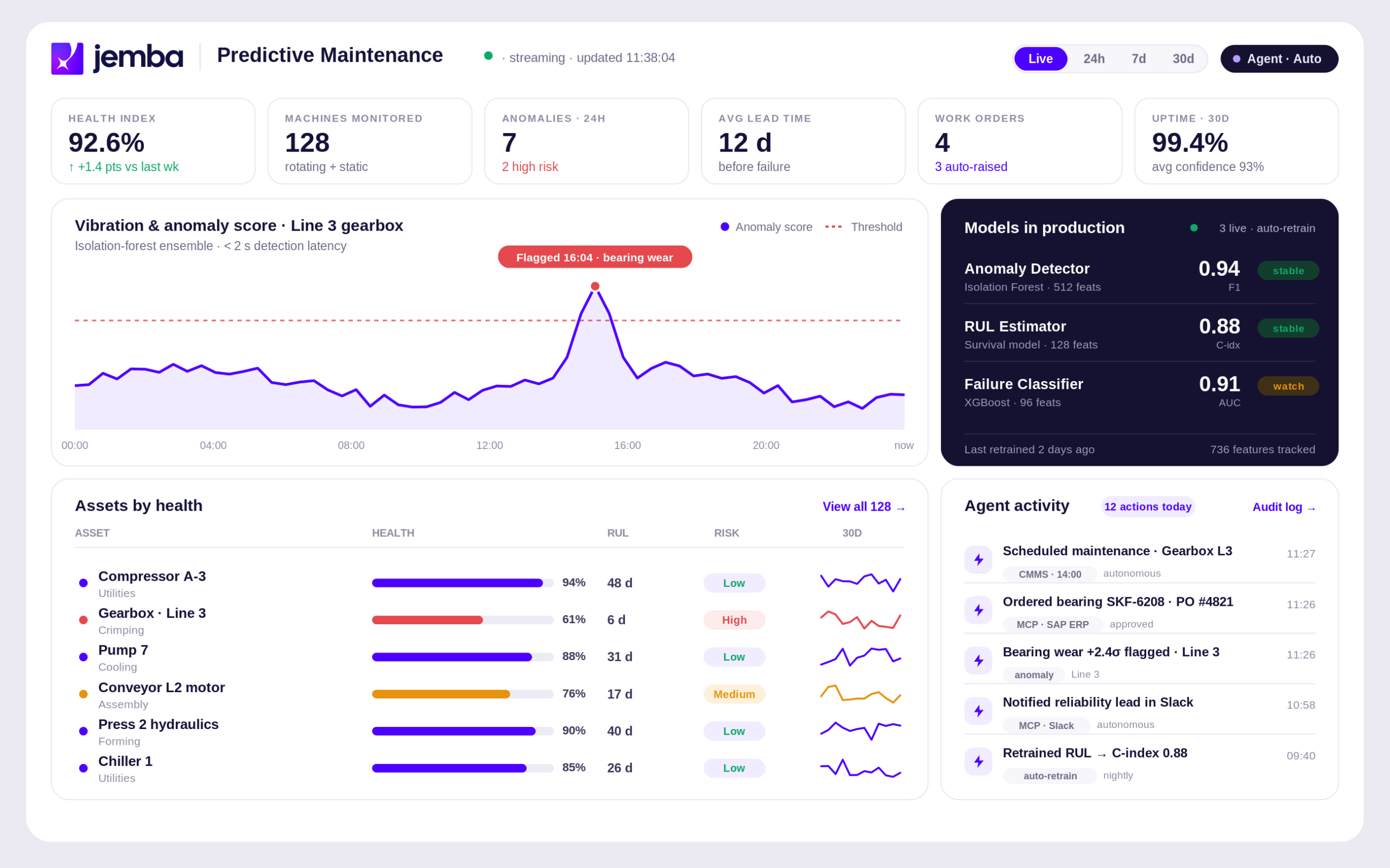
The most widely deployed use case. The ML model learns your equipment normal behaviour and triggers an alert the moment a deviation is detected. Average gain: minus 35% downtime. Time to ROI: 4 to 8 weeks.
2. Quality correlation
Identify which process parameters are driving your quality defects. ML reveals hidden relationships that classical statistical methods miss. Average gain: minus 22% scrap and rework costs.
3. Energy monitoring
Correlate energy consumption with production output to identify avoidable waste. Average gain: minus 20% energy waste.
4. OEE optimisation
Move from measuring OEE to understanding it. The ML platform identifies the 10 variables that explain 80% of performance losses and surfaces the root causes behind each one.
5. Yield prediction
Predict end-of-line yield based on current process parameters. This approach enabled a Tier-1 automotive supplier to go from 30% to 80% yield by correlating 700 variables across 12 lines.
Six criteria for choosing your industrial ML platform
| Criterion | What to require |
|---|---|
| Accessibility | No-code interface usable by process engineers without data training |
| Connectivity | CSV, REST API, native SCADA and historian connectors |
| Time-to-value | First results in under 4 weeks |
| Openness | No proprietary lock-in — your data stays yours |
| Scalability | Multi-line and multi-site deployment without architectural overhead |
| Field references | Documented case studies with quantified ROI in your sector |
Why generic data science tools are not enough for industry
Python, notebooks, generalised AutoML — these tools are unsuited to manufacturing production for three fundamental reasons:
- They require specialist skills your shop floor teams do not have and cannot realistically acquire at scale.
- They do not handle industrial data specifics — industrial timestamps, missing data in continuous processes, sensor drift.
- They do not integrate operational alerts usable by your operators in real time.
This is the value of a dedicated industrial ML platform like Jemba: it solves all three problems natively, and gets you operational in weeks, not years.
Measured results across 360 industrial deployments
- minus 35% production downtime
- minus 22% scrap and rework costs
- minus 20% energy waste
- 4 weeks to first insight
- 2.7 times average year-1 ROI
These figures come from real deployments at leading manufacturers and are documented in our detailed case studies.
See Jemba on your own data
A 30-minute session with a product specialist. No data scientist required, 48-hour setup.


