


Industrial Machine Learning for Predictive Maintenance: How Smart Factories Prevent Downtime
Industrial Machine Learning for Predictive Maintenance: How Smart Factories Prevent Downtime
Industrial machine learning for predictive maintenance has become one of the most powerful levers for reducing unplanned downtime in manufacturing. Unlike traditional preventive maintenance — which schedules interventions at fixed intervals regardless of actual equipment condition — machine learning continuously analyses hundreds of process variables to detect the early warning signals of failure. The result: you intervene at the right time, on the right equipment, before the breakdown occurs.
Why industrial machine learning changes the maintenance equation
Every modern factory generates a continuous stream of data: vibrations, temperatures, pressures, electrical consumption, cycle times. This data contains the real-time signature of your equipment health — but it is too voluminous and too complex to be analysed manually by your maintenance team.
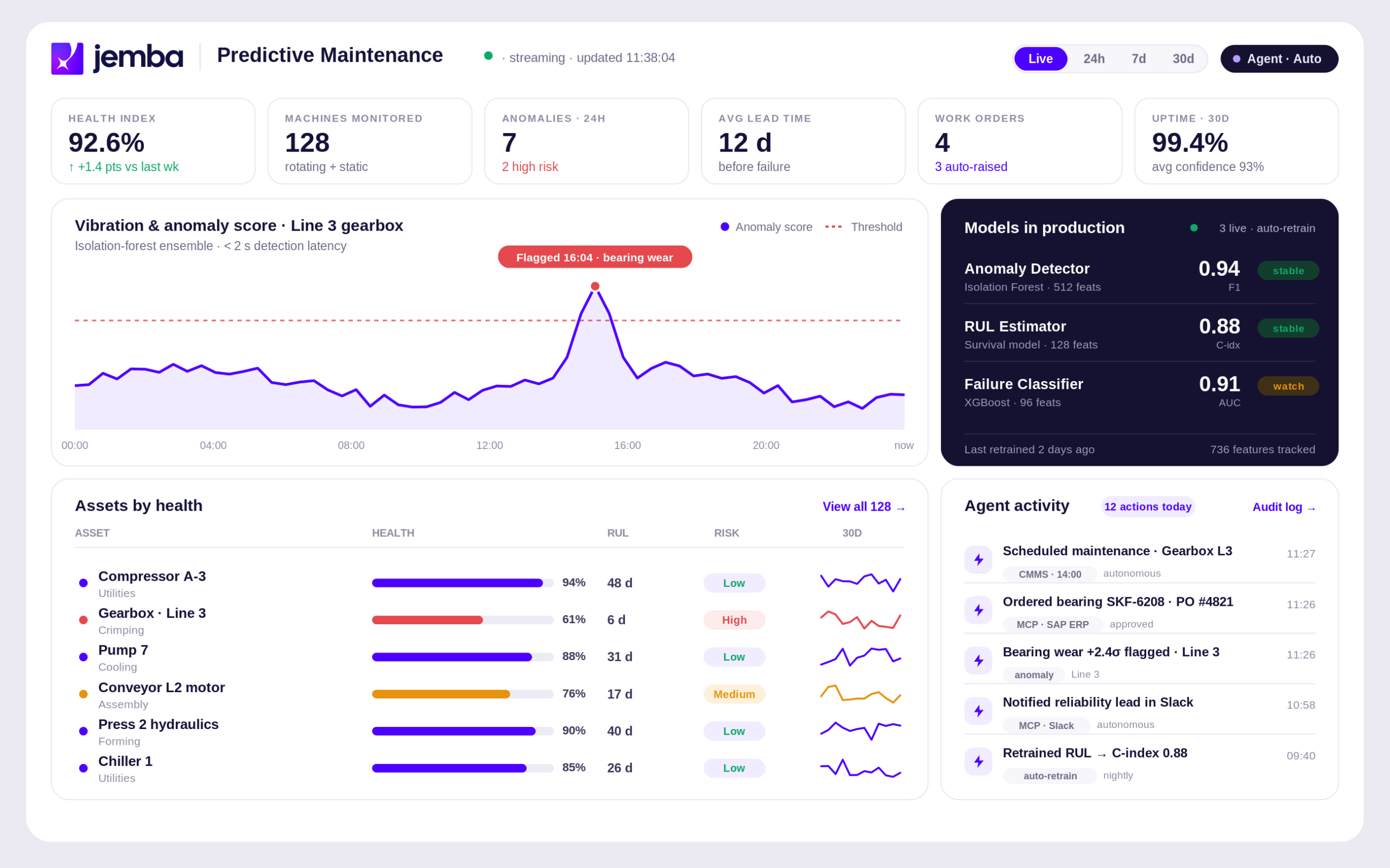
This is precisely where industrial machine learning comes in. By training a model on the historical baseline of your equipment normal operation, the platform learns to recognise abnormal deviations the moment they appear — often hours or days before an actual failure. Alerts reach your operators dashboards in real time, with the affected parameters and criticality level clearly indicated.
Field results speak for themselves: manufacturers deploying ML-based predictive maintenance see an average reduction of 35% in production downtime and significant savings on corrective maintenance costs.
Four types of anomalies detected by machine learning in the factory
An industrial ML model for predictive maintenance does not monitor a single variable in isolation. It correlates hundreds of parameters simultaneously to identify four major anomaly families:
- Vibration anomalies — early indicators of mechanical failure (bearings, gears, imbalances)
- Thermal drift — overheating of motors, lubricants, hydraulic circuits
- Abnormal energy consumption — early signal of wear or miscalibration
- Process instability — pressure, flow rate or cycle time variations outside normal range
By correlating these signals together, the model can identify combinations of variables that appear normal in isolation but whose association reveals an ongoing degradation. This is the power of machine learning applied to industrial predictive maintenance: detecting what the human eye cannot see.
Deploying industrial machine learning for predictive maintenance without a data scientist
One of the most common barriers to ML adoption in industry is the perception of prohibitive technical complexity. Next-generation ML platforms like Jemba have been designed precisely so that your process engineers and maintenance technicians can deploy predictive models without any data science expertise. The process follows four simple steps:
- Data connection — CSV import from your historian, API connection to your SCADA, or live TeepTrak feed
- Project setup — select the target variable and the parameters to analyse
- Automatic training — the ML model trains itself on your historical data, no human intervention required
- Actionable results — real-time alerts, monitoring dashboard, intervention recommendations
From connection to first results: under 4 weeks. No infrastructure change. No new hires.
Case study: from 30% to 80% yield with predictive ML
A French Tier-1 automotive supplier deployed Jemba across 12 production lines in 6 months. By correlating over 700 process variables, the model identified 4 critical parameters responsible for 83% of yield losses.
We deployed Jemba across 12 lines in 6 months. We saved over two million euros in the first year with zero data scientists on staff.
— VP of Operations, Global Tier-1 Automotive Supplier, France
Measured results on this deployment:
- Yield: 30% to 80% (+50 percentage points)
- Scrap: minus 58%
- Year 1 ROI: 2.7 times
- Deployment timeline: 18 weeks
Predictive ML vs preventive maintenance: a comparison
| Criterion | Corrective | Preventive | Predictive ML |
|---|---|---|---|
| Trigger | After failure | Fixed interval | Early signal |
| Unplanned downtime | Frequent | Reduced | minus 35% on average |
| Data scientist required | No | No | No (with Jemba) |
Five questions to ask before choosing an industrial ML predictive maintenance solution
- Is my data accessible? — Your historian, SCADA or IoT sensors must be able to feed the platform.
- Does my team have ML skills? — If not, choose a no-code solution like Jemba.
- What is the time to first results? — Under 4 weeks is the current market benchmark.
- Is the platform open? — Avoid proprietary lock-in. Your ML solution must integrate with your existing infrastructure.
- Is the ROI measurable? — Request documented case studies with real figures, not theoretical projections.
Explore the Jemba case studies and the results measured across our industrial client base.
Conclusion
Industrial machine learning for predictive maintenance is no longer reserved for large enterprises with dedicated data teams. Thanks to next-generation industrial ML platforms, any production director can deploy predictive models on their lines within weeks — using their existing team, without hiring a single data scientist. The results are concrete, measurable, and immediate.
See Jemba on your own data
A 30-minute session with a product specialist. No data scientist required, 48-hour setup.


