
Two algorithm families. One product your team runs.
They answer the two questions every production team asks every day: what is going wrong, and how do we run better. Both are deliberately generic, so they hold across process and discrete manufacturing — you train them on your own data.
“What is going wrong?”
Every signal scored continuously, in real time and across variables together. Thresholds, drifts and alarms are generated automatically, and each flag is traced back to the variables behind it rather than to a composite score nobody can act on.
Because only the past is ever used to produce a score, what you validate offline is what runs on the line.
“How do we run better?”
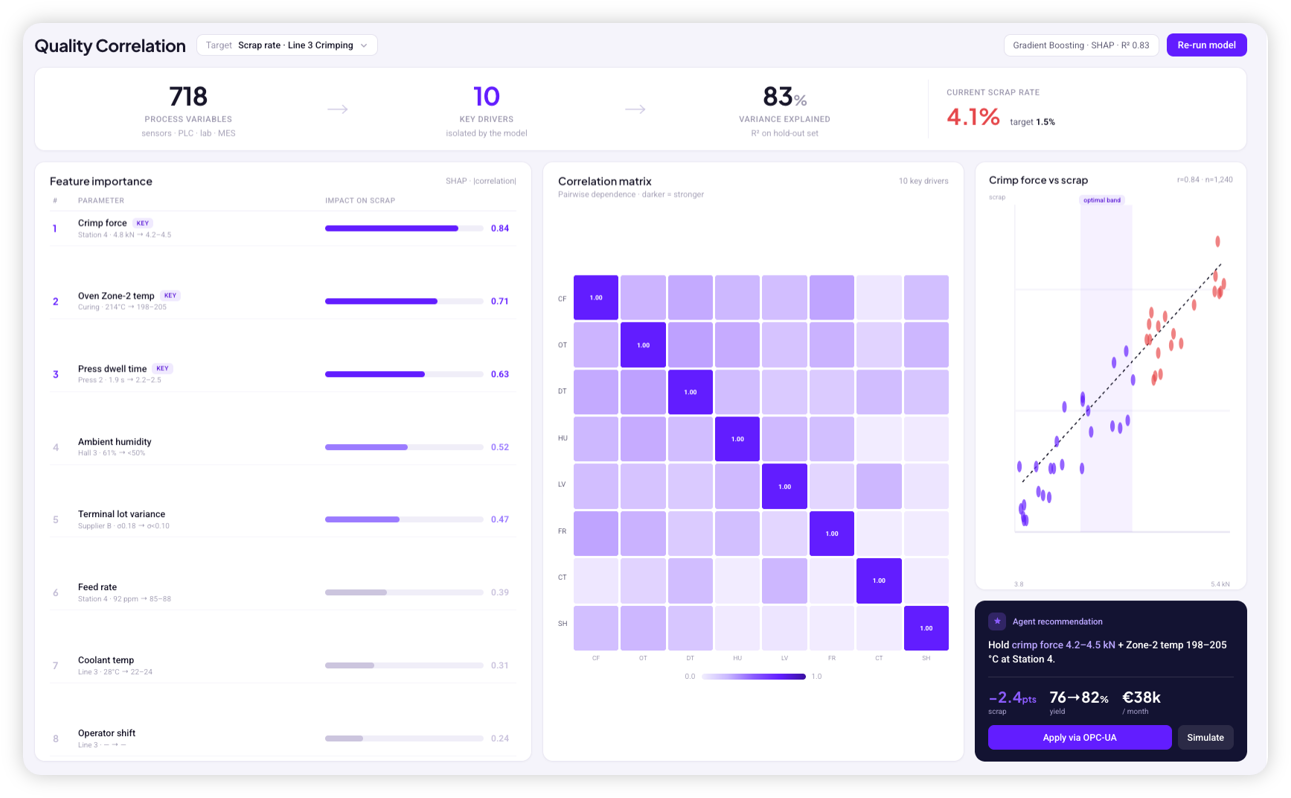
The influence of every variable quantified against your target, and the optimal operating regions identified. What comes back is a setpoint range per retained lever — not a model for someone to interpret — plus the outcome expected inside each zone.
It also predicts outcomes from parameters you have not run yet, with anything beyond your production history labelled as extrapolation.
We did not simplify the data science workflow. We embedded it.
Variable selection, preprocessing, model selection, tuning, calibration and trustability checks all run inside the product. The user never touches them.
- Data
- Any source or format — ingested, cleaned and shaped by us. There is no data-preparation phase asked of your team.
- Model
- Automatic selection, one-click training, and a trustability check before anything is shown to you.
- Application
- Conclusions written for the shop floor, not for reviewers. A production manager connects the data, runs the models, reads the result, and acts.
- After a change
- Retraining a model after a process change takes one click and about thirty seconds, done by your own team.
A model built for one process does not amortise across plants.
First-principles models and digital twins are excellent where they fit, and they have to be rebuilt for every process they touch. That is why they start at six figures and stay at the top of the market.
Trained by you, on you
The two families are deliberately generic so they are robust to any use case, and specific to your plant because they are trained on your plant’s data.
Spreads inside the plant
Built for the plant manager rather than the analyst, which is what lets it spread from one line to the next without a new project each time.
And across plants
The same product covers defect detection, process parameters, energy, OEE and predictive maintenance — in both process and discrete manufacturing.
Name one line and one target variable.
We read the export you already produce and tell you within a week whether it carries the levers.


