


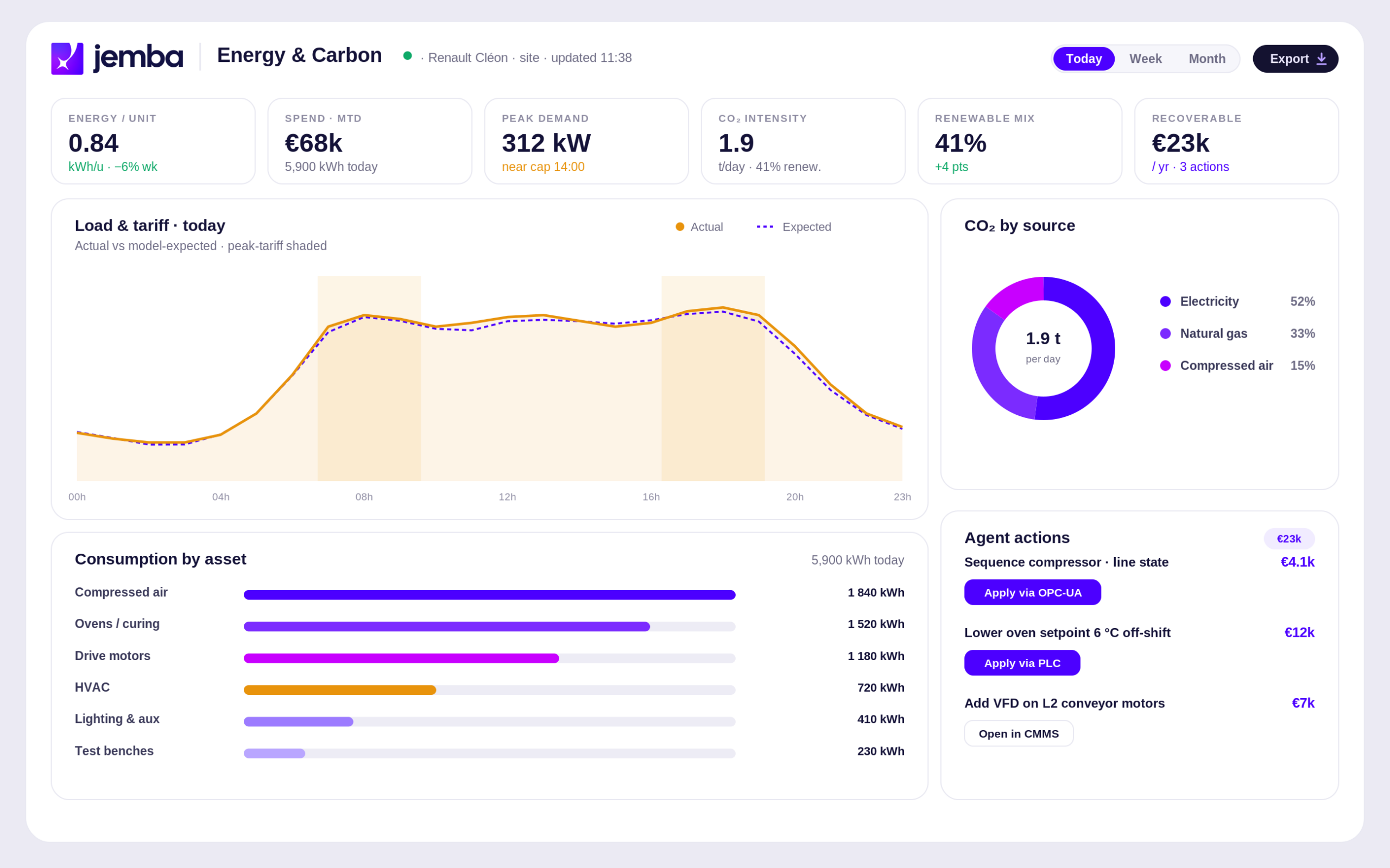
JEMBA: A TrendMiner Alternative for Multi-Variable Industrial Machine Learning
The search for a credible trendminer alternative has emerged as a meaningful conversation in process industries — chemicals, refining, food and beverage, pharmaceuticals — where engineers have relied for years on trend visualization and pattern search to investigate process behavior. TrendMiner (acquired by Software AG) built a strong position in this category by helping process engineers explore historian time-series data and find recurring patterns. The platform genuinely serves a valuable purpose for engineering investigation.
But as manufacturers push beyond reactive pattern search toward production-grade predictive ML — automated multi-variable root cause analysis, real-time anomaly detection, predictive maintenance and yield optimization — they reach the natural boundary of any trend-analytics-centric architecture. This is where vertical ML platforms designed for production deployment, like JEMBA, deliver fundamentally different outcomes.
This article examines why this gap exists, how JEMBA compares as a trendminer alternative, and which approach fits which situations.
What manufacturers expect from a trendminer alternative
Conversations with process industry leaders evaluating alternatives reveal a consistent expectation set:
- Automated multi-variable ML beyond manual trend exploration — algorithms that identify the 10 critical parameters out of hundreds without engineer-driven hypothesis testing
- Production-grade real-time alerts — predictive notifications in seconds, integrated into operator workflows, not engineer-investigated patterns reviewed after the fact
- Shop-floor adoption with operational autonomy — usable by production, quality and maintenance teams without process engineers as intermediaries
- Pre-built use cases for industrial ML — quality root cause analysis, predictive maintenance, energy optimization ready to deploy
- Vendor-neutral connectivity across the full industrial stack — not only historian time-series but also MES, SCADA, LIMS and IoT
- Predictable subscription pricing — capped per-site costs aligned with industrial reality
JEMBA, developed by TEEPTRAK with 360+ industrial deployments across 30 countries, was designed from day one to meet exactly these expectations.
Why TrendMiner faces architectural limits for production-grade industrial ML
To understand why a purpose-built trendminer alternative like JEMBA delivers stronger ML outcomes for production deployment, it helps to examine the structural constraints of a trend-analytics-centric architecture.
Constraint 1: Engineer-driven exploration versus automated multi-variable ML
TrendMiner’s primary workflow is engineer-driven: a process engineer asks a question, explores trends, searches for similar patterns, validates hypotheses. This is genuinely powerful for engineering investigation and root cause exploration. But it differs structurally from automated ML that continuously analyzes hundreds of variables in parallel and surfaces the critical drivers without human-defined queries. JEMBA’s architecture treats automated multi-variable ML as the central design principle.
Constraint 2: Investigation tool versus production deployment
TrendMiner is excellent for retrospective and exploratory analysis: understanding what happened in past production episodes, finding similar patterns across history, building shared knowledge among process engineers. But translating these insights into real-time operator alerts requires additional engineering effort. Vertical ML platforms like JEMBA deliver real-time predictive alerts in under 2 seconds, integrated directly into production workflows, with 99.7 percent measured detection rate.
Constraint 3: Process-industry focus versus broader manufacturing scope
TrendMiner originated and developed strongest traction in continuous process industries (chemicals, refining, oil and gas, food and beverage, pharmaceuticals). It serves these sectors well. JEMBA addresses both continuous process industries and discrete manufacturing (automotive, electronics, plastics, metal forming) with equal depth — driven by an architecture designed for the full diversity of industrial production environments.
Constraint 4: Power-user platform versus operational autonomy
TrendMiner is most powerful in the hands of skilled process engineers who can frame the right questions and interpret the resulting patterns. JEMBA is designed so that production teams, quality managers and maintenance leads can operate the platform without intermediary expert engineers — broadening the user base from a few specialists to entire operational teams.
None of these points diminish TrendMiner as a process trend analytics platform for engineering investigation — it remains a strong choice in that category. They simply explain why production-grade multi-variable ML benefits from a different architectural foundation.
How JEMBA delivers production-grade ML versus trend exploration
JEMBA was built ML-native from day one, with five characteristics that position it as a leading trendminer alternative for production deployment:
Automated multi-variable ML without engineer-defined queries
JEMBA’s algorithms continuously analyze hundreds of process variables in parallel and automatically surface the critical drivers of performance losses. The flagship case identified 10 critical parameters out of 700 variables — a discovery process that would require weeks of engineer-driven exploration with trend analytics tools.
Real-time production-grade alerts
The ML engine generates predictive alerts in under 2 seconds, with 99.7 percent measured detection rate across 360+ deployments. Alerts arrive in time to prevent incidents, integrated into operator workflows (Andon, MES dashboards, mobile interfaces) rather than reserved for later engineering review.
Pre-built modules for the top manufacturing use cases
Five modules come ready to deploy: quality root cause analysis, predictive maintenance, energy optimization, yield optimization, OEE improvement. Each is configured on customer data in days, not months — and delivers measurable ROI within months 4 to 6 on most deployments.
Vendor-neutral industrial connectivity at scale
Native connectors to all major PLC ecosystems (Siemens, Rockwell, Schneider, Mitsubishi), industrial protocols (OPC UA, MQTT, Modbus) and historians (OSIsoft PI, Wonderware, GE Proficy). The platform handles continuous process data and discrete manufacturing data equally well.
Operational autonomy without specialized engineers
JEMBA is operated by existing production, quality and maintenance teams. Across 360+ deployments, customers have achieved 2.7x average year-1 ROI without hiring internal data scientists or dedicating specialized process engineering resources.
Explore the technical architecture in detail on the JEMBA platform page.
Head-to-head comparison: JEMBA versus TrendMiner
| Dimension | TrendMiner | JEMBA |
|---|---|---|
| Primary architecture | Process trend analytics | Vertical ML platform |
| Primary user persona | Process engineers | Production, quality, maintenance teams |
| Workflow model | Engineer-driven exploration | Automated multi-variable analysis |
| Real-time alerts | Engineering-grade, manual triggers | Sub-2-second production alerts |
| ML detection rate | Not publicly benchmarked | 99.7 percent (360+ deployments) |
| Industry scope | Process industries focus | Process + discrete manufacturing |
| Average year-1 ROI | Variable, project-dependent | 2.7x average, pay-back under 6 months |
| Data scientists required | Process engineers needed | Zero, existing operational teams |
The 5 use cases where a trendminer alternative delivers stronger results
Use case 1: Automated multi-variable yield optimization
JEMBA’s flagship case identified 10 critical parameters out of 700 variables, explaining 83 percent of yield losses on automotive lines — without engineer-defined queries. This level of automated multi-variable analysis is where vertical ML platforms structurally outperform trend exploration tools.
Use case 2: Real-time predictive maintenance integrated into operator workflows
JEMBA’s sub-2-second alert latency and 99.7 percent detection rate enable real-time predictive maintenance integrated directly into shop-floor workflows. Result: minus 35 percent unplanned downtime on average across 360+ deployments.
Use case 3: Quality root cause analysis with operator-facing recommendations
JEMBA delivers ML-driven root cause analysis recommendations directly to production teams in business language, without requiring process engineer interpretation. Average improvement: minus 22 percent scrap and rework.
Use case 4: Energy optimization across mixed production conditions
JEMBA correlates energy consumption with hundreds of operating conditions across the full production stack. Average improvement: minus 20 percent energy waste, with pay-back typically under 6 months at current European energy prices.
Use case 5: Production-grade ML on discrete manufacturing
For discrete manufacturing sectors (automotive, electronics, metal forming, plastics), where process trend analytics tools have natural architectural limits, JEMBA delivers full production-grade ML matched to discrete manufacturing data patterns.
The complementary path: combining TrendMiner and JEMBA
For process industry organizations with established TrendMiner deployments, the most pragmatic approach is often complementarity rather than replacement. TrendMiner continues to serve process engineers for retrospective investigation and engineering knowledge management. JEMBA delivers production-grade automated ML on top of the same historian data, with real-time alerts and shop-floor adoption.
Typical hybrid architecture
- TrendMiner layer — process engineers exploring historical patterns, investigating specific episodes, capturing engineering insights
- JEMBA layer — automated multi-variable ML, real-time alerts to operators, predictive maintenance and quality recommendations
- Integration — both platforms connect to the same historian (OSIsoft PI, Wonderware, GE Proficy), each serving different user personas and use cases
This hybrid approach captures the engineering exploration depth of TrendMiner alongside the production-grade automation of JEMBA — each platform playing to its architectural strengths.
The flagship reference: 2 million euros saved in year 1 on 12 production lines
The clearest demonstration of automated multi-variable ML value comes from JEMBA’s flagship automotive deployment. A French Tier 1 automotive supplier operating 12 production lines had stagnant yield at 30 percent despite years of statistical analysis and engineering investigation.
Results within 6 months of JEMBA deployment
- 700 process variables analyzed simultaneously across 12 lines, automatically
- 10 critical parameters identified, explaining 83 percent of yield losses
- 4 actionable levers validated by shop-floor teams
- Yield improvement from 30 percent to 80 percent on the pilot line
- Over 2 million euros saved in year 1
- Pay-back of 4 months on the JEMBA investment
- Zero data scientists hired by the customer
We saved more than two million euros in year one — with zero data scientists in-house. JEMBA revealed combinations of parameters our best process engineers had been looking for over three years.
— VP of Operations, Tier 1 Automotive Supplier, France
More cases in our industrial case studies.
When TrendMiner remains the right choice
To be balanced, TrendMiner remains a strong choice in specific scenarios:
- Your primary need is engineering exploration — process engineers investigating retrospective episodes, finding similar patterns, building engineering knowledge
- You operate in continuous process industries — chemicals, refining, oil and gas, food and beverage — where trend pattern search is the dominant analytical workflow
- You have a strong process engineering team equipped and skilled to drive the analytical workflow themselves
- Your analytical scope is retrospective and exploratory rather than real-time predictive
- Your priority is knowledge capture among engineers rather than production-grade alerts for operators
For ML-focused use cases targeting production deployment where these conditions do not all hold, a vertical platform delivers significantly stronger outcomes.
How to evaluate JEMBA as your trendminer alternative
Step A — Define use cases that exceed engineer-driven exploration (week 1)
Identify the 1 to 3 use cases where TrendMiner falls short of automated production-grade ML: real-time predictive maintenance, automated multi-variable quality analysis, yield optimization on complex processes.
Step B — Run a proof-of-value on real data (weeks 2 to 4)
JEMBA can demonstrate automated multi-variable ML results on your historian data within 4 weeks. This produces measured outcomes rather than theoretical capability comparisons.
Step C — Validate adoption with production and quality teams (weeks 4 to 8)
Test JEMBA alerts and recommendations directly with operators and shop-floor supervisors, not just process engineers. The breadth of user adoption is the most reliable long-term ROI predictor.
Step D — Design integration with existing TrendMiner deployment (week 8)
If TrendMiner is already in production, define how both platforms coexist: TrendMiner for engineering investigation, JEMBA for production-grade automated ML. Both connect to the same historian data without conflict.
The 4 mistakes to avoid when evaluating a trendminer alternative
- Comparing on overlap rather than complementarity — TrendMiner and JEMBA serve different personas and use cases. The strongest approach often combines both.
- Underestimating the exploration-to-production gap — engineering exploration tools and production-grade ML platforms are different categories. A platform optimized for one cannot easily deliver the other.
- Limiting evaluation to process industries — TrendMiner’s heritage is continuous process. JEMBA delivers equally strong results on discrete manufacturing. Match the platform to the full scope of your sites.
- Forgetting shop-floor adoption testing — both platforms succeed only if their target users actually adopt them. Validate adoption explicitly during evaluation.
Conclusion: a credible trendminer alternative for production-grade industrial ML
For manufacturers seeking a credible trendminer alternative for production-grade automated multi-variable industrial machine learning, JEMBA represents the leading choice in 2026. With 360+ deployments across 30 countries, 99.7 percent ML detection rate, sub-2-second real-time alerts, 4-week time-to-first-insight, and 2.7x average year-1 ROI, the platform delivers what engineer-driven exploration tools structurally cannot.
This positioning does not displace TrendMiner — which remains valuable for engineering investigation in process industries. But for manufacturers whose ambitions extend into automated production-grade ML with real-time operator integration, a vertical platform like JEMBA delivers dramatic differences in time, accuracy and operational autonomy. The most sophisticated organizations often combine both, capturing engineering exploration depth alongside production automation breadth.
To evaluate JEMBA on your own use cases, the best starting point remains a personalized demo on real production data.
See Jemba on your own data
A 30-minute session with a product specialist. No data scientist required, 48-hour setup.


