


A Modern Alternative to Rockwell FactoryTalk Analytics for OEE and Machine Learning
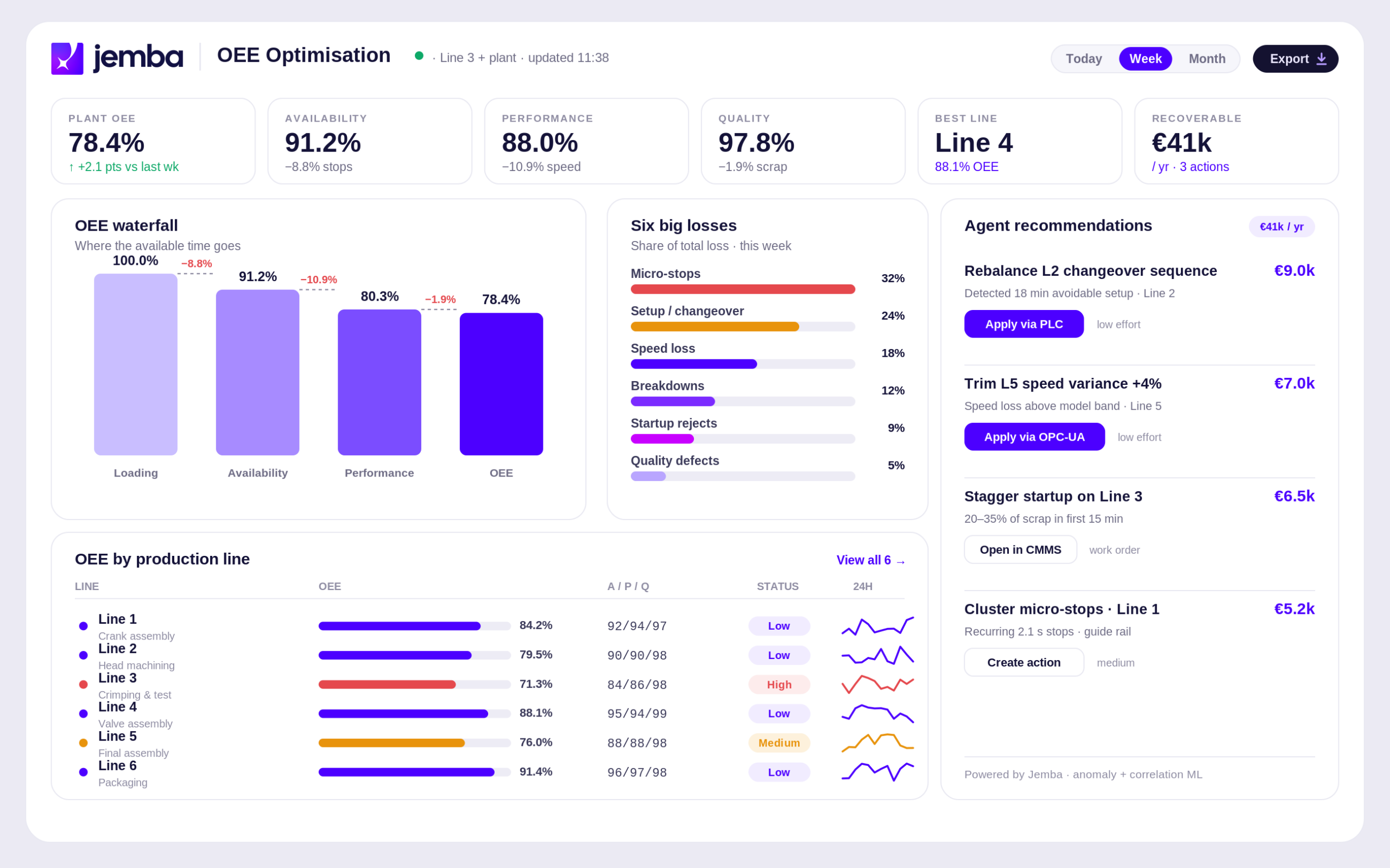
JEMBA: A Modern Rockwell FactoryTalk ML Alternative for OEE and Machine Learning
The search for a credible rockwell factorytalk ml alternative has become one of the most active conversations in industrial software in 2026. Manufacturers who deployed FactoryTalk Analytics expecting a unified platform for OEE measurement and machine learning have discovered, sometimes painfully, the gap between what an extended legacy suite can deliver and what a purpose-built vertical ML platform actually accomplishes in production.
Rockwell FactoryTalk Analytics has its merits: tight integration with Rockwell PLCs and the broader Allen-Bradley ecosystem, mature OEE measurement, and decades of factory floor presence in North America. But when manufacturers push beyond OEE dashboards toward genuine machine learning — predictive maintenance, quality root cause analysis, multi-variable yield optimization — they often hit the structural limits of an architecture that was not designed for modern ML.
This article explains why JEMBA has emerged as the leading rockwell factorytalk ml alternative for manufacturers seeking both robust OEE measurement and production-grade machine learning, with measurable ROI in months rather than years.
What manufacturers expect from a rockwell factorytalk ml alternative
Conversations with industrial leaders evaluating alternatives to FactoryTalk Analytics reveal a consistent set of expectations:
- OEE measurement that works out of the box — automated calculation, line-by-line dashboards, drill-down to root causes, mobile access for shop-floor teams
- Genuine machine learning, not just statistics — multi-variable correlation analysis, anomaly detection on hundreds of process variables, predictive alerts hours or days before incidents
- Vendor independence on hardware — ability to connect to Rockwell, Siemens, Schneider, Mitsubishi and other PLC ecosystems without architectural rework
- Fast time-to-value — measurable results within 8 to 12 weeks, not 12 to 18 months
- No internal data science team required — operated by existing production, quality and maintenance teams
- Predictable total cost of ownership — per-site subscription rather than open-ended consulting and licensing escalation
JEMBA, developed by TEEPTRAK with 360+ deployments across 30 countries, was designed from the ground up to meet exactly these expectations.
Why FactoryTalk Analytics struggles as a pure machine learning platform
To understand why a rockwell factorytalk ml alternative like JEMBA delivers stronger ML outcomes, it is helpful to examine the architectural constraints that any vendor-suite ML extension faces.
Constraint 1: Architecture optimized for PLC integration, not ML
FactoryTalk’s strength is its deep, native integration with the Rockwell PLC ecosystem. This is a real and valuable capability for sites that are predominantly Rockwell-equipped. But the same architectural choices that make PLC integration seamless also impose constraints on what ML the platform can do: heavy reliance on the broader Rockwell stack, optimization for tag-based real-time data rather than ML-ready time-series, and dependence on the Rockwell partner network for advanced analytics deployment.
Constraint 2: Bolt-on machine learning capabilities
FactoryTalk Analytics added machine learning capabilities progressively, layered on top of an existing infrastructure originally built for OEE measurement and SCADA integration. This layered evolution contrasts with platforms like JEMBA, which were architected from day one around ML as the central design principle. The result: ML in JEMBA is faster, more accurate, and easier to deploy.
Constraint 3: Dependence on system integrators for ML use cases
Deploying advanced ML use cases on FactoryTalk typically requires substantial involvement from system integrators or Rockwell professional services. This adds cost, lengthens timelines, and creates dependency on external resources. A vertical ML platform like JEMBA delivers pre-built use cases that customers can configure and operate themselves.
Constraint 4: Limited cross-vendor flexibility
Manufacturers with mixed PLC environments (Rockwell + Siemens + Schneider, for instance) often find FactoryTalk’s architecture more aligned with Rockwell-centric deployments. A vendor-neutral platform like JEMBA connects equally well to any PLC, historian, MES, SCADA or IoT source.
None of these points diminish FactoryTalk Analytics as a SCADA, OEE and tag-management solution. They simply explain why modern ML workloads benefit from a different architectural foundation.
How JEMBA delivers OEE and ML in a single integrated platform
JEMBA addresses the same core needs as FactoryTalk Analytics — OEE measurement, production analytics, predictive insights — but with an architecture built from day one around the requirements of modern industrial machine learning.
Native OEE measurement with ML enrichment
OEE is not an afterthought in JEMBA: it is a core module that combines automated calculation (availability, performance, quality) with ML-driven root cause analysis. Where FactoryTalk Analytics tells you what your OEE is, JEMBA also tells you why it is what it is and what to change to improve it. The platform’s 99.7 percent detection rate translates directly into actionable insights for shop-floor teams.
Multi-variable analysis on hundreds of process variables
JEMBA can simultaneously analyze hundreds, even thousands of process variables to identify the 10 critical parameters that explain 80 percent of performance losses (the 10/80 rule). This level of multi-variable analysis is impractical with traditional analytics architectures.
Predictive alerts in under 2 seconds
The JEMBA ML engine processes incoming data and generates predictive alerts in under 2 seconds. This latency makes real-time operator integration genuinely usable, not just theoretically possible.
Plug-and-play vendor-agnostic connectivity
JEMBA connects natively to Rockwell, Siemens, Schneider, Mitsubishi, Omron, Beckhoff, and any standard industrial protocol (OPC UA, MQTT, Modbus). It also integrates with historian platforms (OSIsoft PI, Wonderware, GE Proficy) and modern IoT hubs. This vendor neutrality matters for any site that is not 100 percent single-vendor.
Explore the architecture in detail on the JEMBA platform page.
Head-to-head comparison: JEMBA versus Rockwell FactoryTalk Analytics
| Dimension | Rockwell FactoryTalk Analytics | JEMBA |
|---|---|---|
| Architecture | Suite with ML extensions added over time | Built ML-native from day one |
| PLC ecosystem fit | Optimized for Rockwell stack | Vendor-neutral across all PLCs |
| Time-to-first-insight | 3 to 9 months typical | 4 weeks |
| Full ML deployment | 9 to 18 months typical | 8 to 12 weeks |
| ML detection rate | Not publicly benchmarked | 99.7 percent across 360+ deployments |
| Internal team required | SI partner + internal IT | Zero data scientists, existing teams |
| Average year-1 ROI | Variable, often beyond year 2 | 2.7x average, pay-back under 6 months |
| Multi-variable analysis | Limited by architecture | 700+ variables simultaneously |
The 5 use cases where a rockwell factorytalk ml alternative delivers stronger results
Use case 1: OEE improvement with ML-driven root cause analysis
FactoryTalk gives you the OEE number. JEMBA gives you the OEE number plus the ML-driven explanation of why losses occur — which variables, which combinations, which conditions. The improvement: +5 to +15 OEE points within 12 months across JEMBA deployments.
Use case 2: Predictive maintenance on mixed equipment fleets
For sites with mixed PLC vendors and equipment brands, JEMBA’s vendor-neutral architecture delivers consistent predictive maintenance across the entire fleet, not just Rockwell-connected assets. Result: minus 35 percent unplanned downtime on average.
Use case 3: Quality root cause analysis across hundreds of variables
JEMBA’s flagship case in automotive identified 10 critical parameters out of 700 variables, explaining 83 percent of yield losses on a Tier 1 supplier’s lines. This level of multi-variable analysis is the area where the architectural advantage of a purpose-built ML platform is most visible.
Use case 4: Energy optimization across production lines
JEMBA correlates energy consumption with production conditions to identify wasteful operating modes. Average improvement: minus 20 percent energy waste, with pay-back typically under 6 months given current energy prices.
Use case 5: Real-time anomaly detection on hundreds of sensors
JEMBA’s sub-2-second response time on hundreds of variables enables genuine real-time anomaly detection that pre-empts incidents rather than just measuring them after the fact.
The flagship reference: 2 million euros saved in year 1 on 12 production lines
The clearest demonstration of what a purpose-built rockwell factorytalk ml alternative can deliver comes from JEMBA’s flagship automotive case. A French Tier 1 automotive supplier operating 12 production lines had stagnant yield at 30 percent despite years of internal analytics efforts. Within 6 months of JEMBA deployment:
- 700 process variables analyzed simultaneously across 12 lines
- 10 critical parameters identified, explaining 83 percent of yield losses
- 4 actionable levers validated by shop-floor teams
- Yield improvement from 30 percent to 80 percent on the pilot line
- Over 2 million euros saved in year 1
- Pay-back of 4 months on the JEMBA investment
- Zero data scientists hired by the customer
We saved more than two million euros in year one — with zero data scientists in-house. JEMBA revealed combinations of parameters our best process engineers had been looking for over three years.
— VP of Operations, Tier 1 Automotive Supplier, France
More cases in our industrial case studies.
When FactoryTalk Analytics may still be the right choice
To be balanced, FactoryTalk Analytics may remain the appropriate choice in specific scenarios:
- You operate a near-100 percent Rockwell-equipped site and your priority is deep SCADA-level integration with Allen-Bradley PLCs rather than multi-variable ML
- You have an established Rockwell SI partner with strong analytics capability and an existing deployment roadmap
- Your ML needs are limited to basic statistical analysis on a small number of variables, not multi-variable correlation analysis on hundreds of inputs
- You are deeply integrated with the broader Rockwell ecosystem (CompactLogix, ControlLogix, PanelView) and want to consolidate vendor relationships
For all other situations, a vertical ML platform delivers significantly better outcomes faster.
How to evaluate JEMBA as your rockwell factorytalk ml alternative
Step A — Identify the highest-value use case (week 1)
Pick the line, equipment or quality issue where the current FactoryTalk deployment falls short — typically a multi-variable problem that resists simple SPC analysis or a predictive maintenance need on non-Rockwell equipment.
Step B — Run a proof-of-value on your data (weeks 2 to 4)
JEMBA can demonstrate concrete results on your own data within 4 weeks. This shifts the conversation from theoretical comparison to measured outcomes.
Step C — Validate with shop-floor teams (weeks 4 to 8)
Have operators, supervisors and quality engineers test the JEMBA alerts against their domain knowledge. The ease of adoption by non-data-scientist teams is the most reliable predictor of long-term value.
Step D — Compare on 3-year TCO and risk (week 8)
Build a financial comparison that includes not just license costs but also internal team requirements, integration timelines and execution risk. JEMBA’s predictable per-site subscription typically wins decisively against open-ended SI engagements.
Total evaluation timeline: 8 weeks. By the end, you have measured results on your own data and a financial case that does not depend on theoretical projections.
The 4 mistakes to avoid when evaluating a rockwell factorytalk ml alternative
- Comparing on feature checklists rather than outcomes — focus on what each platform actually delivers in production, not what marketing materials promise.
- Underestimating the multi-vendor reality — most factories have mixed equipment fleets, and vendor-neutral architectures consistently outperform single-vendor approaches at scale.
- Ignoring time-to-value — a 12 to 18 month deployment timeline accumulates significant opportunity cost. Faster platforms generate ROI compounding from month 4 or 5.
- Forgetting the operator adoption test — the best ML alerts have zero value if shop-floor teams do not act on them. Test adoption explicitly during evaluation.
Conclusion: a credible rockwell factorytalk ml alternative finally exists
For manufacturers seeking a serious rockwell factorytalk ml alternative that delivers both OEE measurement and genuine production-grade machine learning, JEMBA represents the leading choice in 2026. With 360+ deployments across 30 countries, 99.7 percent ML detection rate, 4-week time-to-first-insight and 2.7x average year-1 ROI, the platform has redefined what good looks like in industrial ML.
This does not mean FactoryTalk Analytics is obsolete — it remains valuable in Rockwell-centric deployments focused on SCADA and OEE measurement. But for manufacturers whose ML ambitions extend beyond what a legacy suite can naturally support, the architectural advantage of a purpose-built ML platform like JEMBA delivers dramatic differences in time, cost and outcomes.
To evaluate JEMBA on your specific use cases, the best starting point remains a personalized demo on your own production data.
See Jemba on your own data
A 30-minute session with a product specialist. No data scientist required, 48-hour setup.


