


JEMBA vs SageMaker Azure ML: Turnkey Vertical ML vs Cloud Platforms You Build Yourself
JEMBA vs SageMaker Azure ML: Turnkey Vertical ML vs Cloud Platforms You Build Yourself
The question of jemba vs sagemaker azure is one of the most important strategic decisions facing manufacturing leaders investing in machine learning today. It is not just a comparison between specific products: it captures a fundamental architectural choice between two radically different paradigms for industrial ML deployment.
On one side, hyperscaler cloud platforms — AWS SageMaker and Microsoft Azure Machine Learning — offer powerful, general-purpose ML infrastructure. They are extraordinarily capable, but require you to build your industrial ML application yourself, with internal data science talent, custom integrations and significant ongoing development. On the other side, vertical industrial ML platforms like JEMBA come pre-built for manufacturing use cases. They deliver value in weeks, not years, without a data science team.
This article compares both paradigms head-to-head across architecture, time-to-value, total cost of ownership, internal team requirements and risk profile. The goal is to help manufacturing leaders make an informed choice based on their actual situation — not on marketing claims from either side.
Understanding the fundamental difference in jemba vs sagemaker azure
Before comparing features, it is critical to understand that JEMBA and the hyperscaler ML platforms are not competing in the same product category. They occupy distinct positions in the industrial ML stack, and recognizing this is the first step toward a sound decision.
AWS SageMaker and Azure Machine Learning: horizontal ML platforms
SageMaker and Azure ML are horizontal data science platforms designed to serve every industry from finance to healthcare to manufacturing. They provide infrastructure: notebooks, model training environments, deployment pipelines, MLOps tools. They are powerful, mature and well-documented. But they ship empty: no industrial use cases, no pre-built models, no domain knowledge embedded. You must build everything that matters on top.
JEMBA: a vertical industrial ML platform
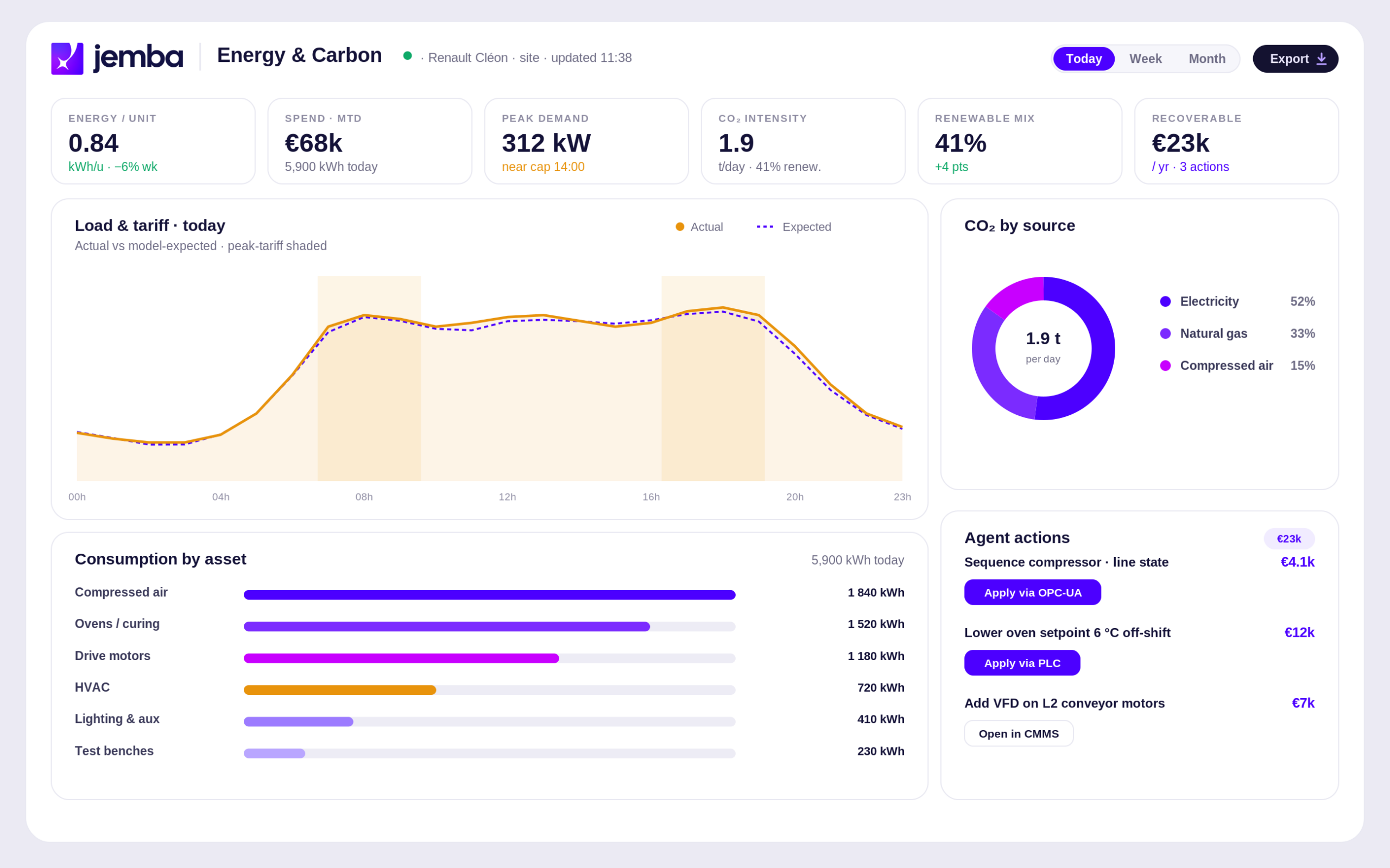
JEMBA is purpose-built for industrial production environments. It comes pre-loaded with five ready-to-use modules covering the highest-value manufacturing use cases: quality root cause analysis, predictive maintenance, energy optimization, yield optimization and OEE improvement. The platform absorbs your historian, MES, SCADA, and IoT data without custom development, and it delivers actionable insights in weeks.
The strategic implication
Choosing between jemba vs sagemaker azure is not “which is better.” It is “which is right for your situation.” If you have a strong internal data science team, a long development horizon, and need maximum flexibility across domains, a hyperscaler may fit. If you need industrial ML value within months without recruiting a data team, a vertical platform like JEMBA is the natural answer.
The head-to-head comparison: jemba vs sagemaker azure across 8 dimensions
Dimension 1: Time-to-first-insight
SageMaker / Azure ML: Typically 6 to 18 months from project kickoff to first operational ML model in production. This timeline includes recruiting or training data scientists, building data pipelines, developing custom models, integrating with industrial systems, and validating in production.
JEMBA: 4 weeks to first actionable insights, 8 to 12 weeks to a full operational deployment with real-time alerts. No data science team required, no custom pipeline development.
The gap is structural: hyperscalers provide tools, JEMBA provides outcomes.
Dimension 2: Internal team requirements
SageMaker / Azure ML: Typically requires a team of 3 to 8 internal specialists for a serious industrial deployment — data scientists, ML engineers, MLOps engineers, data engineers. Annual cost for such a team in Europe or North America: 600 K to 1.5 M euros or USD just for salaries.
JEMBA: Zero data scientists required on the customer side. The platform is operated by existing production, quality and maintenance teams. This is one of JEMBA’s foundational promises, validated across 360+ deployments.
Dimension 3: Total cost of ownership over 3 years
SageMaker / Azure ML: Software costs scale with compute and storage usage (typically tens to hundreds of thousands of euros per year), but the dominant cost is internal team: 600 K to 1.5 M per year. 3-year TCO: typically 2 to 5 million euros for a meaningful industrial deployment, often more.
JEMBA: Per-site subscription model that covers software, support, and ongoing model maintenance. 3-year TCO: a fraction of equivalent hyperscaler builds, with ROI typically positive in year 1.
Dimension 4: Risk profile
SageMaker / Azure ML: High execution risk. Industry surveys consistently report that 60 to 80 percent of industrial ML projects built on horizontal platforms fail to reach production, are abandoned, or do not deliver measurable ROI. The reasons: difficulty hiring scarce talent, scope creep, integration complexity, model drift over time.
JEMBA: Low execution risk. Standardized deployment methodology, 360+ successful deployments as reference, proven 99.7 percent detection rate, 2.7x average year-1 ROI. The platform is validated at scale across automotive, food, pharma, chemicals, plastics and electronics.
Dimension 5: Industrial data integration
SageMaker / Azure ML: Generic data connectors. Integration with industrial systems (Wonderware, OSIsoft PI, GE Proficy, Siemens WinCC, AVEVA, Rockwell FactoryTalk) requires custom development. Time-series alignment, sensor drift handling, and irregular sampling must be coded.
JEMBA: Native industrial connectors. Plug-and-play integration with historians, MES, SCADA, LIMS and IoT platforms. Time-series handling, sensor drift detection and missing data management are built-in.
Dimension 6: Pre-built industrial use cases
SageMaker / Azure ML: No pre-built industrial use cases. Every model is built from scratch. Generic ML tutorials are provided, but none specific to predictive maintenance on rotating equipment, quality root cause analysis for food processing, or yield optimization for chemicals.
JEMBA: Five pre-built industrial modules ready to deploy: quality root cause analysis, predictive maintenance, energy optimization, yield optimization, OEE improvement. Each module is configured on your data in days, not months.
Dimension 7: Explainability for operators
SageMaker / Azure ML: Models output statistical scores. Translating these into actionable recommendations in operator language requires additional development. Production teams typically need a data scientist intermediary to interpret outputs.
JEMBA: Native business-language output. Alerts read like: “Surface defect risk elevated due to oven temperature exceeding 187 degrees combined with raw material humidity above 12 percent.” Operators act directly on the platform’s recommendations.
Dimension 8: Vendor lock-in and data sovereignty
SageMaker / Azure ML: Deep integration with the broader cloud ecosystem (AWS or Azure). Switching costs are high once industrial data, models and pipelines are migrated. Data sovereignty considerations vary by geography and customer policy.
JEMBA: Deployable on multiple infrastructure options. European-built platform (TEEPTRAK is a French scale-up), which matters for European industrial customers facing data sovereignty constraints.
Explore the architecture in detail on the JEMBA platform page.
The flagship case: why a top-tier automotive supplier chose JEMBA over building on AWS
One of the most instructive examples in the jemba vs sagemaker azure debate is a leading French automotive Tier 1 supplier that initially considered building its predictive maintenance and quality analytics on AWS SageMaker. After 18 months of internal evaluation, the company shifted to JEMBA. The reasoning was instructive.
The AWS SageMaker scenario evaluated
- Estimated project duration: 24 to 36 months to reach full production
- Required internal team: 6 to 8 FTEs (data scientists, ML engineers, MLOps)
- Estimated 3-year cost: 4 to 6 million euros all-in
- Execution risk: high, given the lack of internal data science culture
- Time-to-ROI: uncertain, likely beyond 24 months
The JEMBA scenario chosen
- Project duration: 6 months to full multi-line deployment
- Required internal team: 0 data scientists, existing production teams
- 3-year cost: a fraction of the AWS scenario
- Execution risk: low, with 360+ reference deployments
- Time-to-ROI: 4 months pay-back, year-1 ROI above 8x on pilot line
The results delivered by JEMBA in 6 months
- 700 process variables analyzed across 12 production lines
- 10 critical parameters identified explaining 83 percent of yield losses
- Yield improvement from 30 to 80 percent on pilot line
- Over 2 million euros saved in year 1
- Pay-back of 4 months on JEMBA investment
We saved more than two million euros in year one — with zero data scientists in-house. Building this on AWS would have taken us three years and required a team we could not hire.
— VP of Operations, Tier 1 Automotive Supplier, France
More examples in our industrial case studies.
When SageMaker or Azure ML may still be the right choice
To be fair and complete, the hyperscaler approach can be appropriate in specific situations:
- You already have a strong internal data science team with manufacturing expertise — 5+ experienced practitioners
- You need maximum flexibility to build custom ML applications across many use cases that are not addressed by vertical platforms
- You have a long development horizon and are not constrained by year-1 ROI requirements
- You are deeply integrated with the broader hyperscaler ecosystem for non-ML workloads, and want to consolidate
- You operate in a research or pilot mode exploring novel ML approaches, not deploying production manufacturing applications
For all other situations — which represent the vast majority of European and North American manufacturers — a vertical industrial ML platform like JEMBA delivers significantly better outcomes faster, with lower risk and lower total cost.
The 5 questions to ask before choosing between jemba vs sagemaker azure
- What is your target time-to-value? If you need ROI within 12 months, hyperscalers are extremely unlikely to deliver. JEMBA routinely delivers within 4 to 6 months.
- Do you have or can you hire 5+ industrial data scientists? In Europe especially, this profile is scarce, expensive and high-turnover. Building on hyperscalers without this team is a high-risk bet.
- Are your use cases standard or unique? If your needs are quality, maintenance, energy or yield optimization (the 95 percent case), JEMBA already has the modules. If your needs are truly unique, hyperscalers offer more flexibility — at much higher cost.
- What is your tolerance for execution risk? Hyperscaler ML projects have a 60 to 80 percent failure rate in industrial contexts. JEMBA’s deployment success rate exceeds 95 percent.
- What is your data sovereignty requirement? For European industrial customers, JEMBA’s European-built platform may simplify regulatory and contractual constraints.
The architectural choice: tools vs outcomes
The deepest distinction in jemba vs sagemaker azure is philosophical. Hyperscalers sell tools to data scientists. JEMBA sells outcomes to manufacturing operations.
This distinction matters because most manufacturing leaders do not actually need ML tools — they need quality improvement, maintenance optimization, energy reduction, yield maximization. Whether these outcomes are delivered by a vertical platform or by an internally-built solution on a hyperscaler is, ultimately, an implementation detail.
What matters is which path delivers the outcomes faster, more reliably, and at lower cost. For 360+ manufacturers globally, the answer has been JEMBA.
How to evaluate jemba vs sagemaker azure for your specific situation
The cleanest way to compare the two approaches is to run a small structured evaluation:
Step 1: Define 2 to 3 specific use cases
Quality root cause analysis on a problematic SKU. Predictive maintenance on a critical equipment. Energy optimization on an energy-intensive line. Make them concrete.
Step 2: Request a proof-of-value from JEMBA
JEMBA can demonstrate concrete results on your own data within 4 weeks. This shifts the conversation from theoretical comparisons to measured outcomes.
Step 3: Scope the equivalent hyperscaler approach
Have your IT or consulting partner estimate the full cost and timeline of building the same use cases on SageMaker or Azure ML, including team, infrastructure and integration.
Step 4: Compare on a total-cost, total-time and total-risk basis
Avoid comparing only license costs. The dominant cost in hyperscaler approaches is internal team, and the dominant risk is execution.
Conclusion: the right choice depends on your situation, but the bar has shifted
The jemba vs sagemaker azure comparison is no longer a debate about technology capabilities — both paradigms can deliver excellent ML in theory. It is a debate about delivery model, time-to-value, total cost of ownership and execution risk in real industrial environments.
For the majority of European and North American manufacturers — those without large internal data science teams, those with year-1 ROI expectations, those with standard manufacturing use cases — vertical industrial ML platforms like JEMBA deliver dramatically better outcomes than hyperscaler builds. With a 4-week time-to-first-insight, 4-month pay-back, 99.7 percent detection rate, and a track record of 360+ deployments, JEMBA has redefined what good looks like in industrial ML.
To evaluate JEMBA on your own data and compare it concretely to a hyperscaler alternative, the best starting point is a personalized demo.
See Jemba on your own data
A 30-minute session with a product specialist. No data scientist required, 48-hour setup.


