


Why Manufacturers Choose Turnkey ML for Manufacturing Over Cloud DIY Platforms
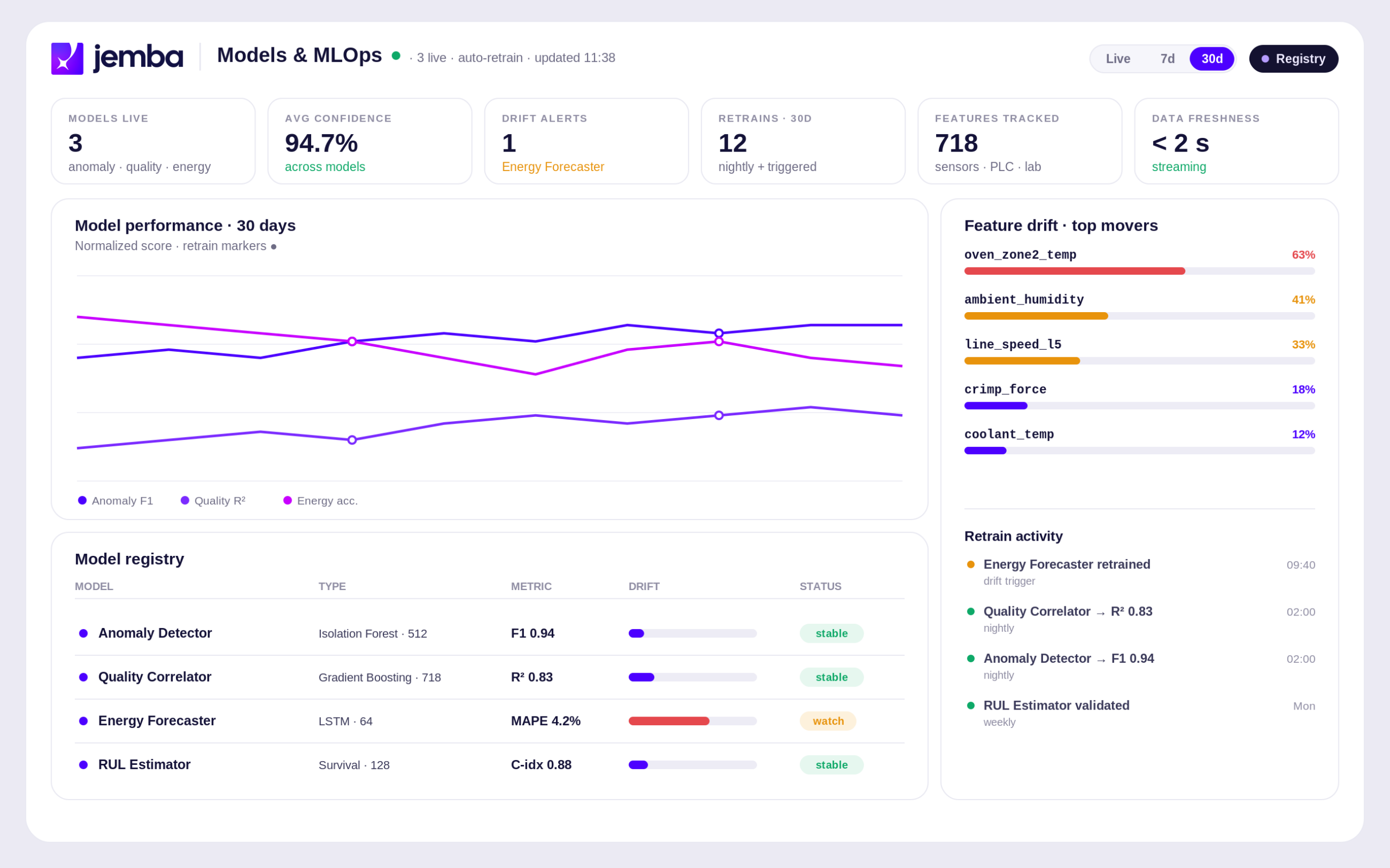
Why Manufacturers Choose Turnkey ML Manufacturing Over Cloud DIY Platforms
The shift toward turnkey ml manufacturing platforms is one of the most significant trends in industrial software in 2026. Across Europe, North America and Asia, manufacturing leaders who once considered building their ML capabilities on cloud DIY platforms (AWS SageMaker, Azure ML, Google Vertex AI, Databricks) are increasingly choosing pre-built vertical alternatives. The reasons are not theoretical — they emerge from years of accumulated experience, both positive and negative, with industrial ML deployments.
This article explores why this shift is happening, what manufacturers have learned about the limits of the DIY approach, and what makes turnkey vertical ML platforms like JEMBA the preferred choice for the majority of industrial use cases today.
The promise of cloud DIY ML platforms in manufacturing
The premise of cloud DIY ML platforms in industrial contexts was compelling. Provide flexible, powerful infrastructure on which manufacturers could build any ML application they needed: predictive maintenance, quality control, energy optimization, yield improvement, supply chain analytics. The flexibility seemed valuable, the major hyperscalers offered enormous investment in tooling, and the scalability promised future-proof architecture.
Many manufacturers invested heavily in this vision between 2018 and 2023. Internal data science teams were built, partnerships with consulting firms were signed, multi-million-euro budgets were committed. The expectation: transform manufacturing operations through bespoke, custom-built ML applications running on world-class cloud infrastructure.
For a minority of large, well-funded organizations with strong technical talent, this approach has delivered results. But for the majority — small and mid-sized manufacturers, and even many large groups without deep data science maturity — the cloud DIY approach has revealed structural limitations that no amount of investment can fully overcome.
The 5 hard lessons that drive manufacturers toward turnkey ml manufacturing
Lesson 1: Hiring industrial data scientists is brutally difficult
Industrial data scientists who combine machine learning expertise with manufacturing domain knowledge are among the rarest profiles in the European and North American job markets. Recruitment timelines stretch 6 to 12 months. Salary expectations have risen dramatically. Turnover within 18 months of joining is common as competing offers escalate. For most manufacturers, building a team of 5+ industrial data scientists is simply not realistic on operational timelines.
Turnkey ML manufacturing platforms remove this constraint entirely: zero data scientists required on the customer side. Existing production, quality and maintenance teams operate the platform with light training.
Lesson 2: Industrial integration is harder than it looks
Connecting cloud ML platforms to industrial data sources (historians like OSIsoft PI, SCADA systems, MES platforms, PLCs, IoT gateways) involves significant complexity: protocol diversity, time-series alignment, sensor drift handling, missing data management, latency constraints. What looks like a “simple data connector” in a slide deck often becomes a 6 to 12 month integration project in reality.
Turnkey vertical platforms come with native industrial connectors validated across hundreds of deployments. Integration is days, not months.
Lesson 3: Building from scratch wastes years of learning
When you build industrial ML on a horizontal platform, every project starts from scratch. The same problems are rediscovered: how to handle irregular sampling, how to deal with regime transitions during product changeovers, how to detect sensor drift, how to make outputs operator-readable. Years of accumulated industry experience are wasted because they cannot be encoded into a generic platform.
Vertical ML platforms embed this learning. JEMBA, with 360+ deployments across 30 countries, has encoded years of industrial pattern recognition into pre-built modules that work out of the box.
Lesson 4: Shop-floor adoption is the actual hard problem
The technical challenge of training accurate ML models is solvable with enough effort. The real hard problem is getting shop-floor operators to use those models in their daily workflow. This requires user interfaces designed for operators, output in business language (not statistical scores), integration with existing tools (Andon boards, MES dashboards), and trust-building over time.
Cloud DIY platforms provide ML infrastructure but not operator workflow design. Vertical platforms make shop-floor adoption a core design principle, not an afterthought.
Lesson 5: Time-to-value matters more than flexibility
Manufacturing leaders increasingly realize that the theoretical advantage of horizontal platforms — maximum flexibility for any use case — is rarely worth the practical cost in time and risk. For most manufacturers, 90 percent of valuable ML use cases fall into a small set of standard categories: quality root cause analysis, predictive maintenance, energy optimization, yield improvement, OEE analytics. For these standard cases, a pre-built solution always wins on speed and reliability.
The 10 percent of truly unique cases that justify horizontal flexibility can be addressed selectively, alongside a vertical platform. But making horizontal the default is a mistake the industry has learned to avoid.
What “turnkey ml manufacturing” actually means in practice
The phrase turnkey ml manufacturing is sometimes used loosely. Here is what it concretely means in the context of a credible vertical platform like JEMBA:
- Pre-built modules for the top manufacturing use cases — quality root cause analysis, predictive maintenance, energy optimization, yield improvement, OEE analytics. Each ready to configure on your data in days.
- Native connectors to industrial systems — historians, MES, SCADA, LIMS, IoT platforms. No custom integration development.
- Standardized deployment methodology — 4 weeks to first insights, 8 to 12 weeks to full operational deployment, validated across hundreds of sites.
- Operator-friendly interfaces — business-language alerts, integration with shop-floor workflows, mobile and desktop access.
- Industrial-grade governance — traceability, explainability, audit trails compatible with manufacturing certifications.
- Single-vendor accountability — one provider responsible for platform, models, integrations, support and ongoing improvements.
Explore the full turnkey architecture on the JEMBA platform page.
The economic case for turnkey ml manufacturing
Cost comparison: turnkey vs cloud DIY over 3 years
The economic comparison reveals why turnkey ml manufacturing wins decisively in most situations:
| Cost Component | Cloud DIY (3-year) | Turnkey ML (3-year) |
|---|---|---|
| Software licenses / subscription | 200 K to 800 K euros | Per-site subscription, capped |
| Internal team salaries | 1.8 to 4.5 M euros | Near zero (existing teams) |
| Consulting and integration | 300 K to 1.2 M euros | Included in subscription |
| Total 3-year TCO | 2.3 to 6.5 M euros | A fraction of cloud DIY |
ROI timeline comparison
Cloud DIY: Positive ROI typically not achieved before year 2 or 3, with high uncertainty given the 60 to 80 percent failure rate of industrial ML projects on horizontal platforms.
Turnkey ML manufacturing: Positive ROI typically achieved in year 1, with pay-back in 4 to 6 months on most deployments. JEMBA’s flagship automotive case: pay-back of 4 months, year-1 ROI above 8x on pilot line.
The flagship case: why a Tier 1 automotive supplier chose turnkey over DIY
One of the clearest demonstrations of the turnkey value proposition comes from a Tier 1 French automotive supplier with 12 production lines. The company initially considered building its ML capabilities on a major cloud DIY platform. After 18 months of internal evaluation and pilot exploration, the leadership team shifted to JEMBA.
The reasoning
- Estimated cloud DIY timeline: 24 to 36 months to reach full production
- Required team: 6 to 8 FTEs that the company could not realistically hire
- Estimated 3-year cost: 4 to 6 million euros all-in
- Execution risk: high, given internal data science maturity
- Time-to-ROI: uncertain, likely beyond 24 months
The results with JEMBA in 6 months
- 700 process variables analyzed across 12 lines
- 10 critical parameters identified explaining 83 percent of yield losses
- Yield improvement from 30 to 80 percent on pilot line
- Over 2 million euros saved in year 1
- Pay-back of 4 months
- Zero data scientists hired
We saved more than two million euros in year one. Building this on cloud DIY would have taken us three years and required a team we could not hire. Turnkey ML was not just faster — it was the only realistic path.
— VP of Operations, Tier 1 Automotive Supplier, France
More examples in our industrial case studies.
The 4 questions every manufacturer should ask before choosing turnkey ml manufacturing
- What is your target time-to-value? If under 12 months, turnkey is essentially the only realistic option. Cloud DIY industrial deployments routinely take 18+ months.
- What is your internal team realistically? If you do not currently employ 5+ industrial data scientists and cannot easily hire them, cloud DIY is a high-risk strategy with low probability of success.
- What are your top 3 use cases? If they are quality, maintenance, energy, yield or OEE — standard manufacturing applications — turnkey wins decisively. If they are truly unique, evaluate hybrid approaches.
- What is your CFO’s view on TCO predictability? Turnkey platforms have predictable, capped subscription costs. Cloud DIY has open-ended team and infrastructure costs that often exceed initial estimates by 50 to 200 percent.
The shift in industrial ML market dynamics
The momentum behind turnkey ML manufacturing platforms is no longer a niche trend. Five concurrent dynamics are reshaping the industrial ML market:
- Data scientist scarcity is structural in Europe and intensifying in North America
- CFO pressure on ML ROI is replacing patient capital strategies with shorter time-to-value requirements
- Reference case maturity in vertical platforms now provides robust proof points (360+ JEMBA deployments)
- Hyperscaler maturity has revealed the structural cost and risk of horizontal industrial builds
- Operator-centric design is increasingly recognized as the critical success factor, favoring platforms designed for shop floors, not data labs
The trajectory points clearly toward vertical, turnkey approaches dominating industrial ML deployments in 2026 and beyond.
How JEMBA delivers on the turnkey ml manufacturing promise
JEMBA, developed by TEEPTRAK, embodies the turnkey vertical ML manufacturing approach with concrete capabilities:
- 99.7 percent ML detection rate measured across 360+ deployments
- Sub-2 second response time from data ingestion to actionable alert
- 4 weeks to first insights, 8 to 12 weeks to full deployment
- 2.7x average year-1 ROI across the installed base
- Minus 35 percent unplanned downtime on average
- Minus 22 percent scrap and rework on average
- Minus 20 percent energy waste on average
- 360+ plants deployed across 30 countries
- European-built with data sovereignty options
These metrics are consolidated from the installed base, not extrapolated from isolated cases. They represent what a credible turnkey ML manufacturing platform can reasonably deliver in 2026.
Conclusion: turnkey ml manufacturing as the new industry standard
The era of building industrial ML from scratch on horizontal cloud platforms is ending for the majority of manufacturers. The combination of data scientist scarcity, CFO ROI pressure, integration complexity and adoption challenges has shifted the balance decisively toward turnkey ml manufacturing approaches.
This shift does not mean cloud DIY platforms are obsolete — they remain valuable for organizations with the right talent, time, and unique use cases. But for the 90 percent of manufacturers who need standard ML capabilities (quality, maintenance, energy, yield, OEE) delivered fast, reliably and affordably, turnkey vertical platforms have become the rational default.
JEMBA represents the European reference in this category, with proven results across automotive, food, pharma, chemicals, plastics and electronics. To evaluate whether the turnkey approach fits your manufacturing context, the best starting point remains a personalized demo on your own production data.
See Jemba on your own data
A 30-minute session with a product specialist. No data scientist required, 48-hour setup.


