
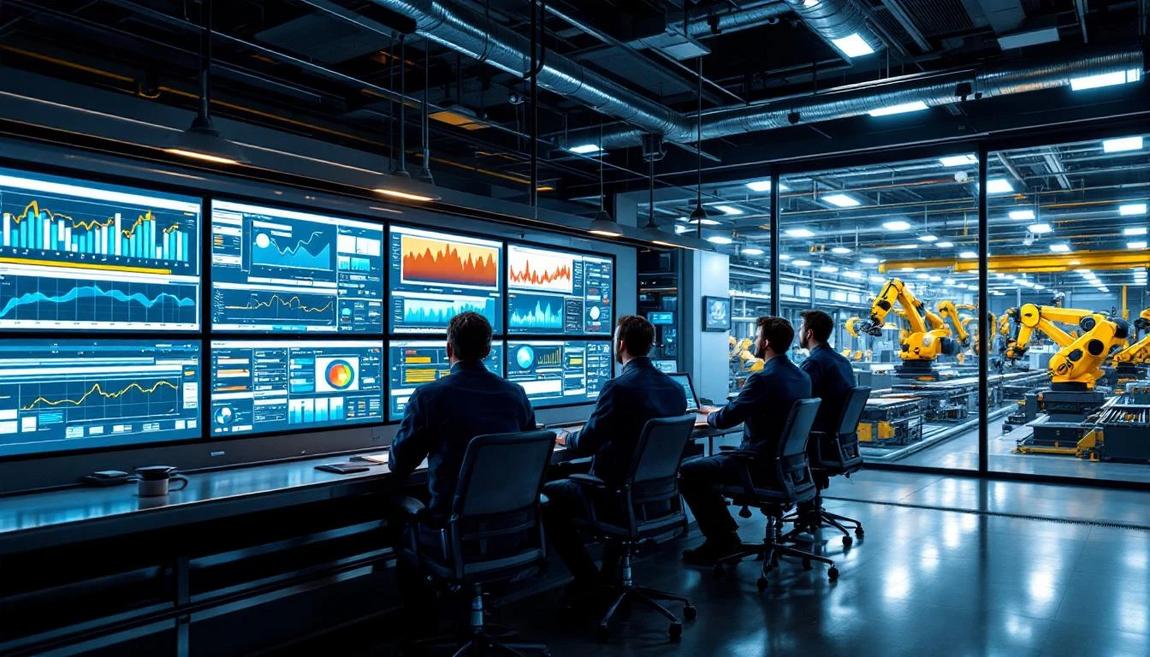

A Modern GE Digital Smart Factory ML Alternative for Predictive Manufacturing
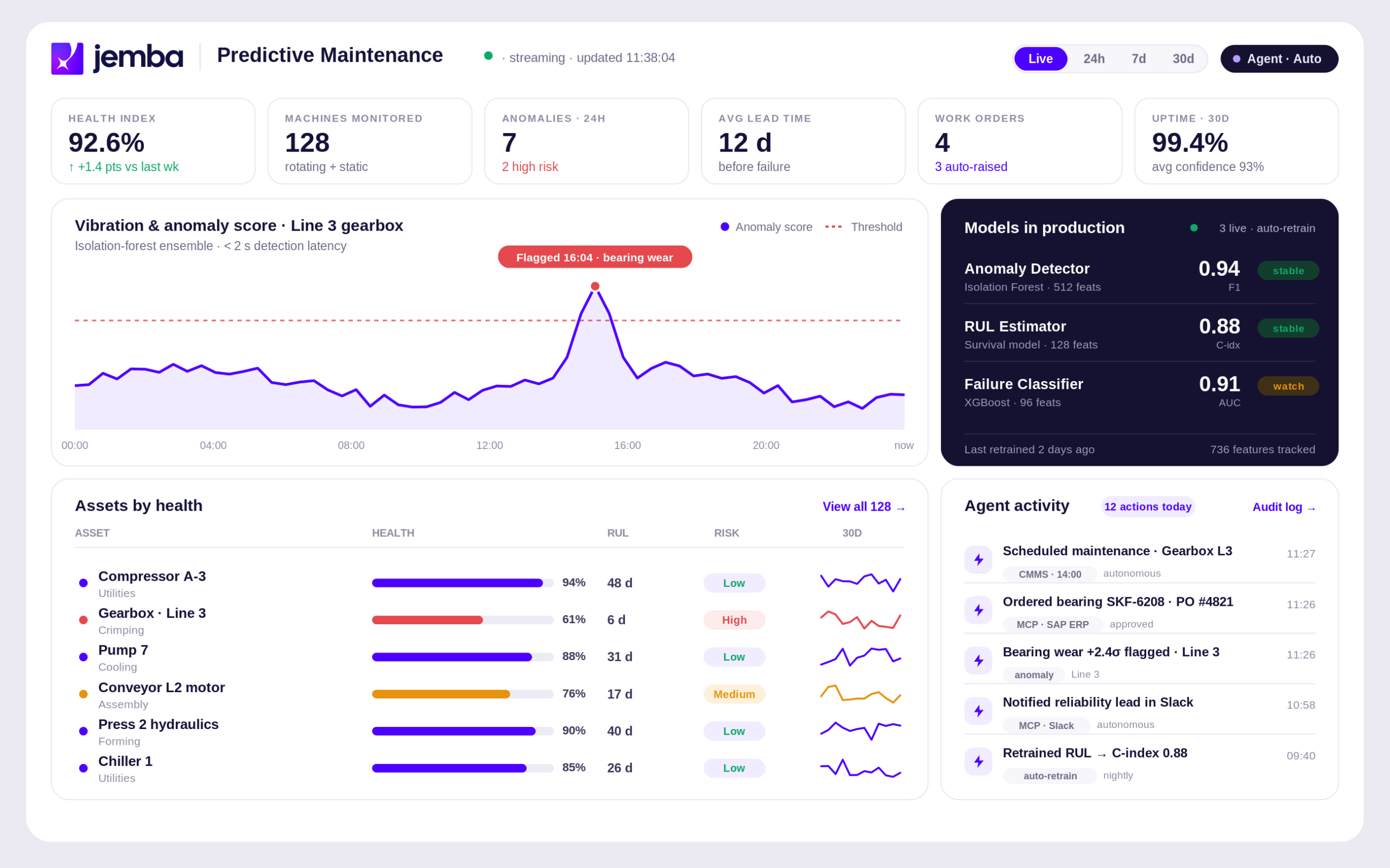
JEMBA: A Modern GE Digital Smart Factory ML Alternative for Predictive Manufacturing
The search for a credible ge digital smart factory ml alternative has accelerated significantly in 2026 as manufacturers seek faster time-to-value, simpler architecture and vendor-neutral connectivity for industrial machine learning. GE Digital Smart Factory portfolio (Proficy, Predix-derived components, Plant Applications) brings strong heritage in industrial software and asset management, particularly in heavy industry. But when manufacturers push toward focused multi-variable ML — predictive maintenance, quality root cause analysis, yield optimization on hundreds of process variables — the broader platform footprint and SI dependence often slow time-to-value.
JEMBA, developed by TEEPTRAK with 360+ industrial deployments across 30 countries, has emerged as the leading European ge digital smart factory ml alternative for manufacturers seeking modern machine learning with predictable cost and rapid deployment. This article examines why this shift is happening, how the two platforms compare, and which approach fits which situations.
What manufacturers expect from a ge digital smart factory ml alternative
Interviews with manufacturing leaders evaluating alternatives reveal a consistent expectation set:
- Predictive analytics that actually predicts — multi-variable ML on hundreds of inputs, anomaly detection with proven detection rates, alerts hours or days before incidents
- Vendor-neutral connectivity — full compatibility across GE, Siemens, Rockwell, Schneider and other PLC ecosystems without architectural rework
- Fast time-to-value — measurable insights within 4 weeks, full operational deployment within 12 weeks
- Shop-floor adoption by existing teams — usable by production, quality and maintenance staff without internal data scientists
- Predictable per-site economics — subscription pricing rather than open-ended professional services engagements
- European data sovereignty options — increasingly relevant for European industrial customers
JEMBA was designed from day one to meet exactly these expectations, with a vertical ML architecture that contrasts structurally with the broader Smart Factory suites.
Why GE Digital Smart Factory’s ML capabilities face architectural constraints
To understand why a purpose-built ge digital smart factory ml alternative delivers stronger ML outcomes for focused use cases, it helps to examine the structural constraints any broad smart factory suite faces.
Constraint 1: Heritage in asset performance management, not multi-variable ML
GE Digital’s strongest heritage is in asset performance management, particularly for heavy industrial assets (power generation, oil and gas, aviation). The platform has expanded into broader manufacturing ML, but the foundational architecture reflects its asset-management origins rather than a clean-sheet ML-native design. By contrast, JEMBA was built ML-native from day one with multi-variable analysis as its central design principle.
Constraint 2: Wide footprint with significant SI dependence
The GE Digital Smart Factory portfolio is broad, covering MES, asset management, supervisory control and analytics. Deploying advanced ML use cases typically requires substantial SI partner engagement, professional services and integration work. This adds cost, lengthens timelines and creates external resource dependency that vertical platforms avoid.
Constraint 3: Predix legacy and platform transitions
GE Digital’s industrial IoT platform Predix went through significant strategic shifts over the past decade. Customers who invested in earlier platform iterations have faced migration considerations as the portfolio evolved. A focused vertical platform like JEMBA offers a simpler, more stable architectural commitment for customers prioritizing predictable platform evolution.
Constraint 4: Enterprise-centric deployment model
GE Digital deployments typically target large industrial enterprises with multi-year transformation budgets and substantial internal IT and OT capabilities. Mid-sized manufacturers, or focused ML projects within large groups, often find the resource and timeline requirements disproportionate to the actual ML scope.
None of these points diminish GE Digital as a broad smart factory provider — it remains relevant for specific heavy-industry contexts. They simply explain why focused multi-variable ML workloads benefit from a different architectural foundation.
How JEMBA delivers predictive manufacturing in a focused ML platform
JEMBA was built ML-native from day one, with five characteristics that explain its growing adoption as the leading ge digital smart factory ml alternative:
Pre-built ML modules for the top manufacturing use cases
Five modules come ready to deploy: quality root cause analysis, predictive maintenance, energy optimization, yield optimization, OEE improvement. Each is configured on customer data in days rather than months, eliminating typical suite-extension customization cycles.
Vendor-neutral connectivity at scale
Native connectors to all major PLC ecosystems (GE, Siemens, Rockwell, Schneider, Mitsubishi, Omron, Beckhoff), to industrial protocols (OPC UA, MQTT, Modbus) and to common historians (OSIsoft PI, Wonderware, GE Proficy). Sites with mixed equipment handled transparently.
Multi-variable analysis on hundreds of inputs
JEMBA simultaneously analyzes hundreds, even thousands of process variables to identify the 10 critical parameters that explain 80 percent of performance losses (the 10/80 rule). This multi-variable depth is impractical with architectures designed primarily for asset-by-asset monitoring.
Sub-2-second response time on real-time data
The ML engine generates predictive alerts in under 2 seconds, enabling genuine real-time operator integration. Alerts arrive in time to prevent incidents, not just to document them after the fact.
Zero data scientists required, operational autonomy
JEMBA is operated by existing production, quality and maintenance teams. Across 360+ deployments, customers have achieved 2.7x average year-1 ROI without hiring internal data scientists or engaging large SI teams.
Explore the technical architecture in detail on the JEMBA platform page.
Head-to-head comparison: JEMBA versus GE Digital Smart Factory
| Dimension | GE Digital Smart Factory | JEMBA |
|---|---|---|
| Primary architecture | Broad smart factory suite | Focused vertical ML platform |
| Heritage | Asset performance management | Multi-variable industrial ML |
| Time-to-first-insight | 6 to 12 months typical | 4 weeks |
| Full ML deployment | 12 to 24 months typical | 8 to 12 weeks |
| SI partner dependence | High | Minimal |
| Internal team required | Internal data + SI resources | Existing operational teams |
| ML detection rate | Not publicly benchmarked | 99.7 percent (360+ sites) |
| Average year-1 ROI | Variable, often beyond year 2 | 2.7x average |
| Pricing model | Modular + services | Predictable per-site subscription |
The 5 use cases where a ge digital smart factory ml alternative delivers stronger results
Use case 1: Multi-variable predictive maintenance at scale
JEMBA’s vendor-neutral architecture and multi-variable analysis deliver consistent predictive maintenance across mixed equipment fleets, not just specific asset families. Result across 360+ deployments: minus 35 percent unplanned downtime on average.
Use case 2: Quality root cause analysis on complex products
For products with complex manufacturing (automotive components, electronics, specialty chemicals, biotech), multi-variable ML identifies defect causes that escape traditional analysis. Flagship case: 700 variables analyzed, 10 critical parameters identified, yield from 30 to 80 percent on pilot line.
Use case 3: Real-time anomaly detection on hundreds of sensors
JEMBA’s sub-2-second response time enables true real-time anomaly detection that pre-empts incidents. This is the area where the architectural advantage of a purpose-built ML platform shows most clearly versus broader smart factory suites.
Use case 4: Energy optimization across production lines
JEMBA correlates energy consumption with production conditions to identify wasteful operating modes. Average improvement: minus 20 percent energy waste, with pay-back typically under 6 months at current European energy prices.
Use case 5: Focused ML on mid-sized sites without enterprise transformation budgets
Mid-sized manufacturers seeking targeted ML value without committing to a full smart factory transformation find JEMBA deployment model — 8 to 12 weeks, subscription pricing, operational autonomy — significantly better aligned with their resources and timelines.
When GE Digital Smart Factory remains the right choice
To be balanced, GE Digital Smart Factory portfolio remains relevant in specific scenarios:
- You operate heavy industrial assets (power generation, oil and gas, aviation maintenance) where GE asset performance heritage is uniquely strong
- You need a broad smart factory suite covering MES, supervisory control, asset management and analytics as an integrated bundle from a single vendor
- You have an established GE Digital SI partner relationship and multi-year transformation roadmap aligned with the broader GE Digital ecosystem
- You are part of a global enterprise already deeply committed to the GE Digital stack across multiple sites and use cases
For focused ML projects where these conditions do not all hold, a vertical platform delivers significantly better speed, simplicity and ROI.
The flagship reference: 2 million euros saved in year 1 on 12 production lines
The clearest demonstration of vertical ML value comes from JEMBA’s flagship automotive deployment. A French Tier 1 automotive supplier operating 12 production lines had stagnant yield at 30 percent despite years of internal analytics efforts using a combination of MES, SCADA and statistical tools.
Results within 6 months of JEMBA deployment
- 700 process variables analyzed simultaneously across 12 lines
- 10 critical parameters identified, explaining 83 percent of yield losses
- 4 actionable levers validated by shop-floor teams
- Yield improvement from 30 percent to 80 percent on the pilot line
- Over 2 million euros saved in year 1
- Pay-back of 4 months on the JEMBA investment
- Zero data scientists hired by the customer
We saved more than two million euros in year one — with zero data scientists in-house. JEMBA revealed combinations of parameters our best process engineers had been looking for over three years.
— VP of Operations, Tier 1 Automotive Supplier, France
More examples in our industrial case studies.
How to evaluate JEMBA as your ge digital smart factory ml alternative
Step A — Define focused ML use cases (week 1)
Identify the 1 to 3 ML use cases where current tooling falls short: multi-variable yield optimization on a specific product, predictive maintenance on mixed-vendor equipment, quality root cause analysis on a problematic SKU.
Step B — Run a proof-of-value on real data (weeks 2 to 4)
JEMBA demonstrates concrete results on customer data within 4 weeks. This produces measured outcomes rather than theoretical comparisons or vendor demonstrations.
Step C — Validate operator and team adoption (weeks 4 to 8)
Have production supervisors, quality engineers and maintenance teams test JEMBA alerts against domain knowledge. Adoption ease is the most reliable predictor of long-term ROI.
Step D — Build the financial and risk comparison (week 8)
Compare 3-year TCO including software, internal resources, SI partner fees and risk-adjusted timelines. JEMBA’s predictable subscription typically wins decisively for focused ML use cases.
The 4 mistakes to avoid when evaluating a ge digital smart factory ml alternative
- Comparing on suite breadth rather than ML outcomes — GE Digital has broader portfolio coverage than JEMBA by design. Compare on the specific ML outcomes you actually need, not on unrelated capabilities.
- Underestimating SI partner cost and timeline — broader suites typically require larger SI engagements that add cost, timeline and execution risk. Factor these into the TCO comparison.
- Ignoring time-to-value — 12 to 24 month deployments accumulate substantial opportunity cost. Faster platforms generate ROI compounding from month 4 or 5.
- Forgetting operator adoption — even sophisticated ML alerts are worthless if shop-floor teams cannot act on them. Test adoption explicitly during evaluation.
Conclusion: a credible ge digital smart factory ml alternative finally exists
For manufacturers seeking a serious ge digital smart factory ml alternative that delivers focused multi-variable industrial machine learning faster and at lower TCO, JEMBA represents the leading choice in 2026. With 360+ deployments across 30 countries, 99.7 percent ML detection rate, 4-week time-to-first-insight, vendor-neutral connectivity and European data sovereignty options, the platform has redefined what good looks like for focused industrial ML.
This positioning does not displace GE Digital as a broad smart factory provider — the company remains relevant in heavy-industry contexts with deep historical roots in asset performance management. But for manufacturers whose ML ambitions are focused, urgent and multi-vendor in nature, a vertical platform like JEMBA delivers dramatic advantages in time, cost and ROI.
To evaluate JEMBA on your own use cases, the best starting point remains a personalized demo on real production data.
See Jemba on your own data
A 30-minute session with a product specialist. No data scientist required, 48-hour setup.


