


A Modern Siemens Opcenter ML Alternative for Multi-Variable Industrial Analytics
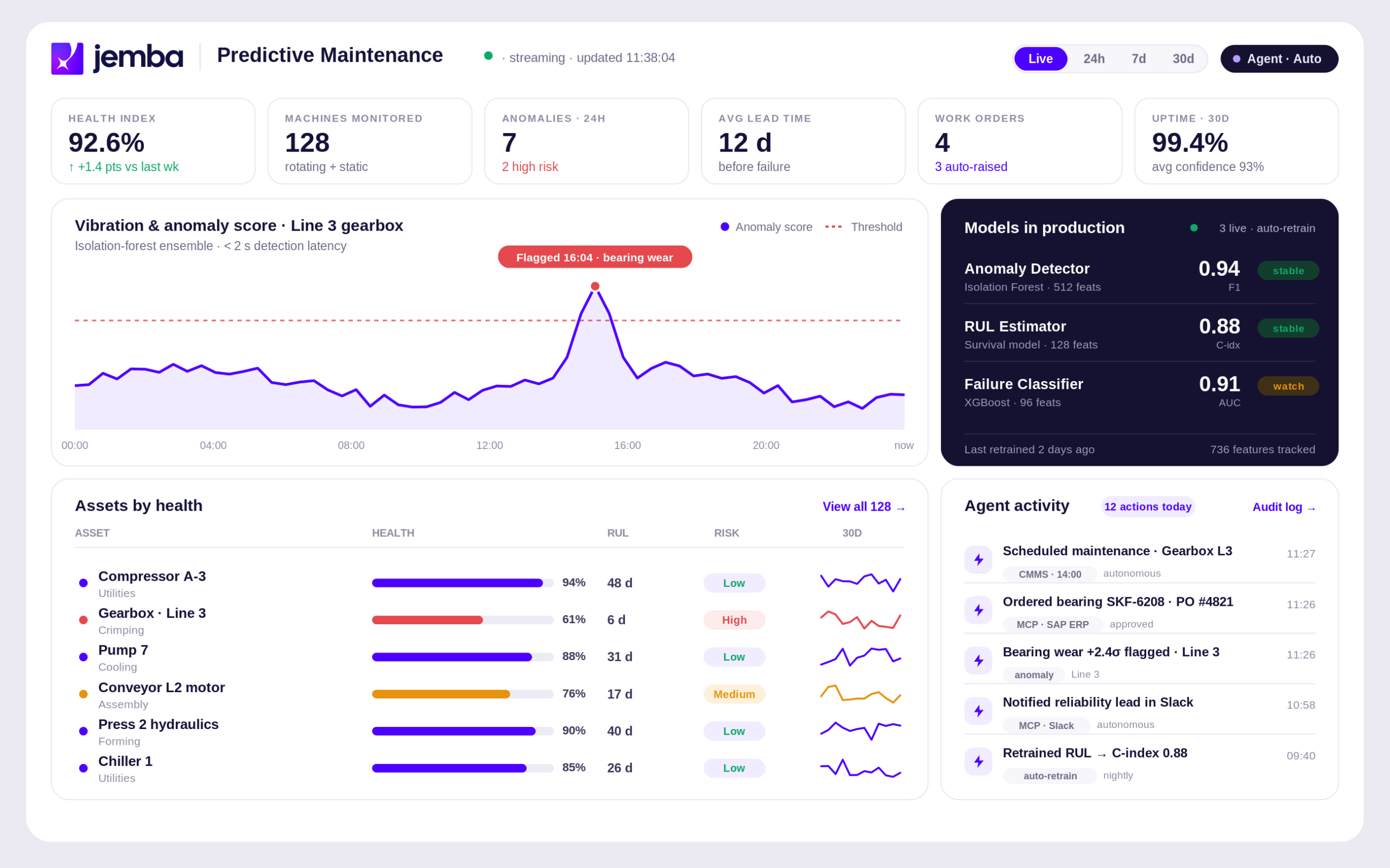
JEMBA: A Modern Siemens Opcenter ML Alternative for Multi-Variable Industrial Analytics
The search for a credible siemens opcenter ml alternative has accelerated significantly in 2026, driven by manufacturers seeking faster time-to-value, vendor neutrality and a more flexible architecture for industrial machine learning. Siemens Opcenter remains an established MES suite with deep integration in the broader Siemens automation portfolio, but when manufacturers push toward genuine multi-variable ML — predictive maintenance, quality root cause analysis, yield optimization on hundreds of process variables — the architectural choices that made Opcenter successful as an MES platform become limitations.
JEMBA, developed by TEEPTRAK with 360+ industrial deployments across 30 countries, has emerged as the leading European siemens opcenter ml alternative for manufacturers seeking to combine modern machine learning with vendor independence. This article examines why this trend is happening, how the two platforms compare, and which approach fits which situations.
What manufacturers expect from a siemens opcenter ml alternative
Discussions with industrial decision-makers reveal a clear pattern in what they seek when evaluating alternatives:
- Genuine machine learning, not statistical extensions — multi-variable correlation analysis on hundreds of inputs, anomaly detection with proven detection rates, predictive alerts measured in seconds
- Vendor-neutral architecture — full compatibility with Siemens, Rockwell, Schneider, Mitsubishi and other PLC ecosystems
- Time-to-value in weeks — measurable insights within 4 weeks, full operational deployment within 12 weeks
- Operational autonomy — usable by production, quality and maintenance teams without internal data scientists
- European data sovereignty options — important for European manufacturers facing regulatory or contractual constraints
- Predictable subscription pricing — capped per-site costs rather than open-ended professional services engagements
JEMBA was designed from day one to meet exactly these expectations, with a vertical industrial ML architecture that contrasts structurally with horizontal MES suite extensions.
Why Opcenter’s ML extensions face architectural constraints
To understand why a purpose-built siemens opcenter ml alternative like JEMBA delivers stronger ML outcomes, it helps to examine the structural constraints any MES-suite ML extension faces.
Constraint 1: MES-first architecture, ML-second
Opcenter’s primary design intent is manufacturing execution: scheduling, production tracking, quality management, recipe handling, batch reporting. ML capabilities have been added progressively on top of this core. By contrast, JEMBA’s architecture treats multi-variable ML analysis as the central design principle, with production data flowing through ML-optimized pipelines from the start.
Constraint 2: Deep coupling to the broader Siemens stack
Opcenter is most powerful when deployed alongside Siemens SIMATIC PLCs, Teamcenter for PLM, MindSphere for IoT and the wider Siemens digital twin ecosystem. This coupling delivers value for Siemens-centric sites but adds complexity and cost for sites running mixed PLC environments — which represents the majority of factories globally.
Constraint 3: Large-enterprise focus and long deployment cycles
Opcenter deployments typically target large enterprises with substantial internal IT and OT capabilities, multi-year roadmaps and significant SI partner engagement. Smaller or mid-sized manufacturers, or even large groups seeking faster value, often find the deployment cycle and resource requirements disproportionate to a focused ML use case.
Constraint 4: Variable adoption of advanced ML use cases
Like most MES-suite ML extensions, Opcenter’s advanced ML capabilities are heavily dependent on SI partners for deployment and customization. This adds external resource dependency, lengthens timelines, and creates ongoing knowledge-transfer challenges that purpose-built vertical platforms avoid.
None of these points diminish Opcenter as an MES platform — it remains a strong choice for large Siemens-centric organizations. They simply explain why modern multi-variable ML workloads benefit from a different architectural foundation.
How JEMBA delivers vertical ML for industrial environments
JEMBA was built ML-native from day one, with five characteristics that explain its growing adoption as the leading European siemens opcenter ml alternative:
Pre-built ML modules for the top manufacturing use cases
Five modules come pre-loaded and ready to deploy: quality root cause analysis, predictive maintenance, energy optimization, yield optimization, OEE improvement. Each is configured on customer data in days rather than months, eliminating the typical MES-extension customization cycle.
Vendor-neutral industrial connectivity
Native connectors to all major PLC ecosystems (Siemens, Rockwell, Schneider, Mitsubishi, Omron, Beckhoff), to standard industrial protocols (OPC UA, MQTT, Modbus, S7) and to common historians (OSIsoft PI, Wonderware, GE Proficy). Mixed PLC environments are handled transparently.
Multi-variable analysis at scale
JEMBA simultaneously analyzes hundreds, even thousands of process variables to identify the 10 critical parameters that explain 80 percent of performance losses. This level of multi-variable analysis is impractical with MES-extension architectures designed primarily for variable-by-variable monitoring.
Sub-2-second response time
The ML engine generates predictive alerts in under 2 seconds, enabling genuine real-time operator integration. Alerts arrive in time to prevent incidents, not just to log them after the fact.
Zero data scientists required
JEMBA is operated by existing production, quality and maintenance teams. Across 360+ deployments, customers have achieved 2.7x average year-1 ROI without hiring a single internal data scientist.
Explore the technical architecture in detail on the JEMBA platform page.
Head-to-head comparison: JEMBA versus Siemens Opcenter
| Dimension | Siemens Opcenter | JEMBA |
|---|---|---|
| Primary architecture | MES suite with ML extensions | Vertical ML platform |
| PLC ecosystem fit | Best with Siemens stack | Vendor-neutral |
| Time-to-first-insight | 6 to 12 months typical | 4 weeks |
| Full ML deployment | 12 to 24 months typical | 8 to 12 weeks |
| SI partner dependence | High | Minimal |
| Internal team required | IT + OT + SI resources | Existing operational teams |
| ML detection rate | Not publicly benchmarked | 99.7 percent (360+ sites) |
| Average year-1 ROI | Variable, often beyond year 2 | 2.7x average |
| European data sovereignty | Available with constraints | Native (European platform) |
The 5 use cases where a siemens opcenter ml alternative delivers stronger results
Use case 1: Multi-variable yield optimization
JEMBA’s ability to simultaneously analyze hundreds of process variables identifies optimization levers that single-variable or limited-multi-variable approaches miss. Flagship case: 700 variables analyzed, 10 critical parameters identified, yield improvement from 30 to 80 percent on a pilot line.
Use case 2: Predictive maintenance across mixed equipment fleets
Most factories have mixed PLC environments. JEMBA’s vendor-neutral architecture delivers consistent predictive maintenance across the entire fleet rather than only Siemens-connected assets. Result: minus 35 percent unplanned downtime on average.
Use case 3: Quality root cause analysis on complex products
For products with complex manufacturing processes (automotive components, biotech, specialty chemicals, electronics), the multi-variable ML capability identifies defect causes that escape traditional MES-quality analysis. Average improvement: minus 22 percent scrap and rework.
Use case 4: Real-time energy optimization
JEMBA correlates energy consumption with production conditions across the full production stack. This is particularly valuable in 2026 given sustained European energy price pressure. Average improvement: minus 20 percent energy waste.
Use case 5: Fast-deploy ML on smaller or mid-sized sites
For sites that lack the budget or resources for a full Opcenter MES deployment, JEMBA delivers focused ML value with deployment in 8 to 12 weeks and operational autonomy without internal data science staff.
When Siemens Opcenter remains the right choice
To be balanced, Opcenter remains the strong choice in specific scenarios:
- You operate a large enterprise with predominantly Siemens-equipped sites seeking deep MES + automation + PLM consolidation
- Your priority is comprehensive MES functionality (production scheduling, recipe management, quality, batch reporting, regulatory documentation) rather than focused ML
- You have an established Siemens SI partner relationship and multi-year digital transformation roadmap aligned with the broader Siemens digital twin vision
- You are deeply integrated with Teamcenter for PLM and want unified PLM-MES integration
For ML-focused use cases where these conditions do not all hold, a purpose-built vertical platform delivers significantly better speed, simplicity and ROI.
The flagship reference: 2 million euros saved in year 1 on 12 production lines
The clearest demonstration of vertical ML value comes from JEMBA’s flagship automotive deployment. A French Tier 1 automotive supplier operating 12 production lines had stagnant yield at 30 percent despite years of internal analytics efforts using a combination of MES, SCADA and statistical tools.
Results within 6 months of JEMBA deployment
- 700 process variables analyzed simultaneously across 12 lines
- 10 critical parameters identified, explaining 83 percent of yield losses
- 4 actionable levers validated by shop-floor teams
- Yield improvement from 30 percent to 80 percent on the pilot line
- Over 2 million euros saved in year 1
- Pay-back of 4 months on the JEMBA investment
- Zero data scientists hired by the customer
We saved more than two million euros in year one — with zero data scientists in-house. JEMBA revealed combinations of parameters our best process engineers had been looking for over three years.
— VP of Operations, Tier 1 Automotive Supplier, France
More examples in our industrial case studies.
How to evaluate JEMBA as your siemens opcenter ml alternative
Step A — Define focused ML use cases (week 1)
Identify the 1 to 3 ML use cases where current tooling falls short: multi-variable yield optimization on a specific product, predictive maintenance on mixed-vendor equipment, quality root cause analysis on a problematic SKU.
Step B — Run a proof-of-value on real data (weeks 2 to 4)
JEMBA demonstrates concrete results on customer data within 4 weeks. This produces measured outcomes rather than theoretical comparisons.
Step C — Test operator and team adoption (weeks 4 to 8)
Have production supervisors and quality engineers validate JEMBA alerts against domain knowledge. Ease of adoption is the most reliable predictor of long-term ROI.
Step D — Build the financial and risk comparison (week 8)
Compare 3-year TCO including software, internal resources, SI partner fees and risk-adjusted timelines. JEMBA’s predictable subscription typically wins decisively for focused ML use cases.
The 4 mistakes to avoid when evaluating a siemens opcenter ml alternative
- Comparing only on feature lists — Opcenter has more MES features than JEMBA by design. Compare on the specific ML outcomes you actually need, not on the breadth of unrelated capabilities.
- Underestimating multi-vendor complexity — most factories have mixed PLC environments where vendor-neutral architectures consistently outperform single-vendor approaches.
- Ignoring deployment timeline reality — Opcenter ML extensions take 12 to 24 months in production. JEMBA delivers in 8 to 12 weeks. The accumulated value of faster deployment is enormous.
- Forgetting operator adoption — even the best ML alerts are worthless if shop-floor teams cannot act on them. Test adoption explicitly during the evaluation phase.
Conclusion: a credible siemens opcenter ml alternative finally exists
For manufacturers seeking a serious siemens opcenter ml alternative that delivers genuine multi-variable industrial machine learning faster and at lower TCO, JEMBA represents the leading European choice in 2026. With 360+ deployments worldwide, 99.7 percent ML detection rate, 4-week time-to-first-insight, vendor-neutral connectivity and European data sovereignty, the platform has redefined what good looks like for focused industrial ML.
This positioning does not displace Opcenter as a broad MES suite — Siemens remains a strong choice for large enterprises pursuing comprehensive Siemens-stack consolidation. But for manufacturers whose ML ambitions are focused, urgent and multi-vendor in nature, a vertical platform like JEMBA delivers dramatic advantages in time, cost and ROI.
To evaluate JEMBA on your own use cases, the best starting point remains a personalized demo on real production data.
See Jemba on your own data
A 30-minute session with a product specialist. No data scientist required, 48-hour setup.


