


Vertical ML Platforms vs Horizontal AI Platforms for Manufacturing: A Strategic Comparison
Vertical ML Platform Manufacturing vs Horizontal AI Platforms: A Strategic Comparison
The choice of a vertical ml platform manufacturing versus a horizontal AI platform is one of the most consequential strategic decisions facing industrial leaders investing in machine learning today. It determines not just what technology you adopt, but how long your project will take, how much it will cost, who you need to hire, and how likely you are to see real ROI.
Yet the distinction between vertical and horizontal ML platforms remains poorly understood by many manufacturing leaders. Vendors on both sides muddy the waters: hyperscalers position themselves as “ready for manufacturing” while vertical platforms claim to offer “the flexibility of cloud.” The reality is more nuanced, and getting it right matters enormously.
This article clarifies the strategic difference between the two paradigms, explains when each is appropriate, and provides a structured framework for choosing the right approach for your specific manufacturing context.
What is a vertical ml platform manufacturing
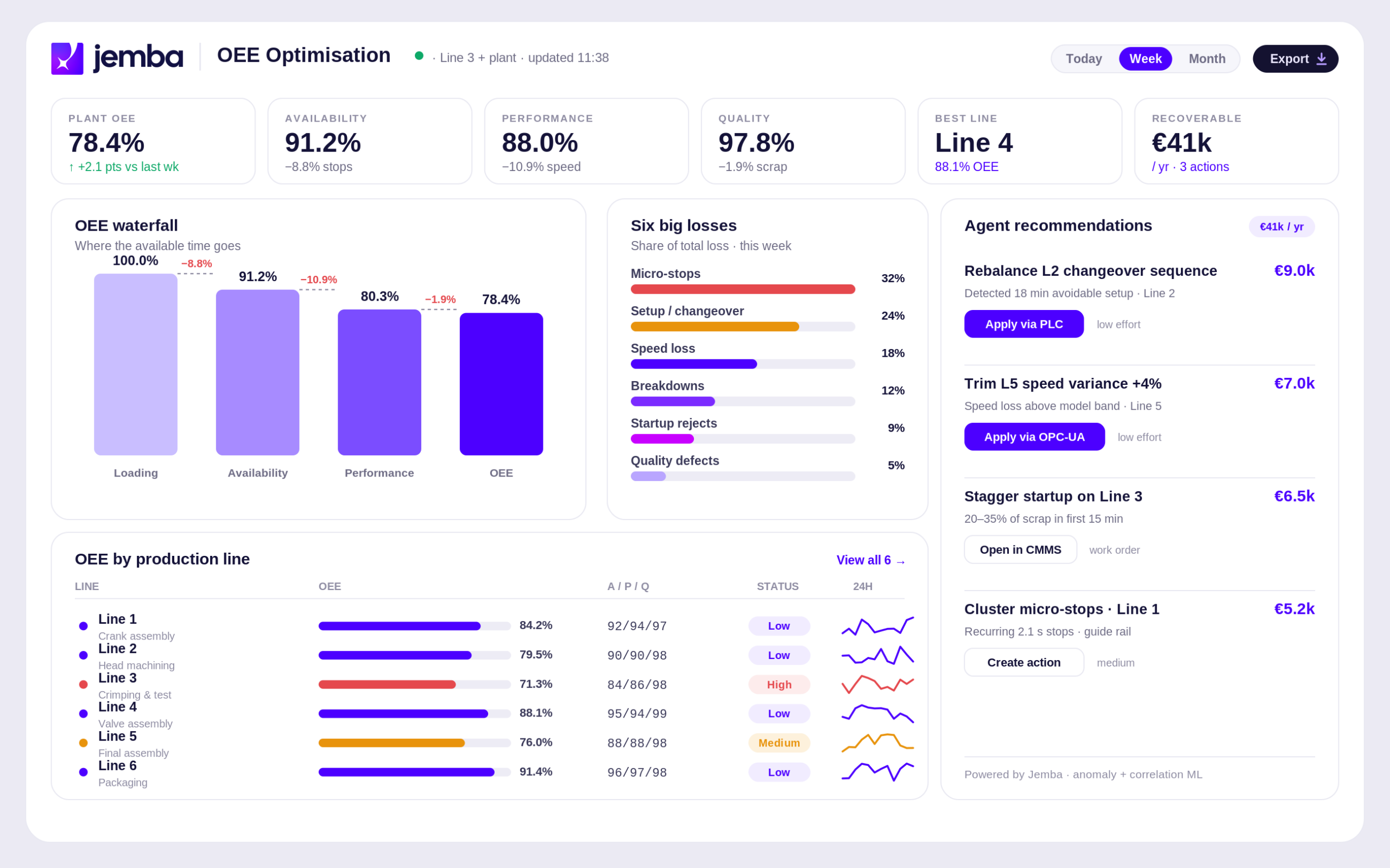
A vertical ML platform for manufacturing is purpose-built for industrial production environments. It comes pre-loaded with the specific capabilities, integrations, models and workflows that manufacturers need — not generic ML infrastructure that you must configure yourself.
The 5 defining characteristics
- Pre-built industrial use cases — quality root cause analysis, predictive maintenance, energy optimization, yield improvement, OEE analytics. Each capability is ready to deploy in days, not months.
- Native industrial data connectors — plug-and-play integration with historians (OSIsoft PI, Wonderware, GE Proficy), MES (SAP ME, Rockwell FactoryTalk), SCADA, LIMS, and IoT platforms.
- Specialized algorithms for industrial time-series — handling of irregular sampling, sensor drift, missing data, regime transitions, multi-variable correlations specific to manufacturing.
- Business-language output — recommendations and alerts in operator-friendly terms, not statistical scores requiring data scientist interpretation.
- Industry-specific governance — traceability and explainability designed for manufacturing audits, quality certifications (IATF 16949, IFS, BRC, GMP) and regulatory requirements.
JEMBA, developed by TEEPTRAK, is the leading European example of a vertical ML platform manufacturing today, with 360+ deployments worldwide.
What is a horizontal AI platform
A horizontal AI platform is general-purpose ML infrastructure designed to serve any industry: finance, healthcare, retail, manufacturing, etc. Major examples include AWS SageMaker, Microsoft Azure Machine Learning, Google Vertex AI, and Databricks. These platforms provide powerful, flexible foundations — but they are intentionally generic.
The 5 defining characteristics
- Generic ML infrastructure — notebooks, training environments, model registries, deployment pipelines. Powerful, but not pre-configured for any specific domain.
- Generic data connectors — APIs and SDKs that work with any data source, but require custom development for industrial systems integration.
- Generic algorithms library — comprehensive toolkit (scikit-learn, TensorFlow, PyTorch, MLflow), but no industrial-specific pre-built models.
- Technical output — model scores, statistical metrics, distributions. Translation into business language requires additional development.
- Generic governance — MLOps tools applicable to any domain, but no manufacturing-specific audit or compliance support out of the box.
The strategic comparison across 8 manufacturing dimensions
To decide between a vertical ml platform manufacturing and a horizontal AI platform, evaluate the two paradigms across the dimensions that actually matter in industrial contexts.
Dimension 1: Time-to-value
Vertical: 4 weeks to first insights, 8 to 12 weeks to full operational deployment. Standardized methodology validated across hundreds of sites.
Horizontal: 6 to 18 months including team building, data pipeline development, custom model creation, integration with industrial systems, and validation. Variable execution risk.
Dimension 2: Internal team requirements
Vertical: Zero data scientists required on customer side. Operated by existing production, quality and maintenance teams. Industrial domain expertise is the primary requirement, not data science.
Horizontal: 3 to 8 internal specialists typically required for serious industrial deployment: data scientists, ML engineers, MLOps engineers, data engineers. Annual European or North American team cost: 600 K to 1.5 M euros or USD.
Dimension 3: Total cost of ownership over 3 years
Vertical: Per-site subscription that covers software, support, ongoing model maintenance, and standard updates. Positive ROI typically achieved in year 1.
Horizontal: Software costs scale with usage (compute, storage, API calls). Dominant cost is internal team. 3-year TCO typically 2 to 5 million euros for meaningful industrial deployment.
Dimension 4: Industrial integration depth
Vertical: Native connectors for industrial systems, time-series handling, sensor drift detection, missing data management built-in.
Horizontal: Generic data connectors. Industrial integration requires custom development. Time-series specifics must be coded.
Dimension 5: Domain knowledge embedded
Vertical: Pre-built use cases incorporate manufacturing best practices, common failure modes, typical correlations. Years of industrial deployment experience encoded in the platform.
Horizontal: No embedded domain knowledge. Every project starts from scratch. Manufacturing-specific patterns must be discovered through trial and error by the internal team.
Dimension 6: Operator and shop-floor adoption
Vertical: Output in business language, integration with existing operator workflows (Andon, MES dashboards, maintenance systems). Adoption by shop-floor teams is the central design principle.
Horizontal: Output in technical terms. Translation layer for operators must be built. Shop-floor adoption is an afterthought, not a design priority.
Dimension 7: Risk profile
Vertical: Low execution risk. Standardized deployment methodology, hundreds of reference deployments, proven performance metrics. JEMBA reports 95+ percent deployment success rate.
Horizontal: High execution risk. Industry surveys report 60 to 80 percent failure rate for industrial ML projects built on horizontal platforms. Causes: difficulty hiring scarce talent, scope creep, integration complexity, model drift.
Dimension 8: Flexibility for unique use cases
Vertical: Optimized for the 90 percent of manufacturing use cases (quality, maintenance, energy, yield, OEE). Unique cases not covered by the platform may require extensions.
Horizontal: Maximum flexibility. Any use case can be built, given sufficient time, budget and talent. The platform itself imposes no constraints.
Explore how JEMBA addresses these dimensions in detail on the JEMBA platform page.
When to choose a vertical ml platform manufacturing
A vertical ML platform like JEMBA is the right choice in the following situations, which represent the vast majority of manufacturing scenarios:
- Your use cases are standard manufacturing applications — quality root cause analysis, predictive maintenance, energy optimization, yield improvement, OEE analytics
- You need ROI within 12 months — vertical platforms routinely deliver pay-back in 4 to 6 months
- You do not have or cannot easily hire 5+ industrial data scientists — most European and North American manufacturers face significant talent constraints
- You want to minimize execution risk — vertical platforms have proven track records across hundreds of deployments
- Your priority is shop-floor adoption, not technical sophistication — operators will use the platform, not data scientists
- You operate under industry-specific regulations — IATF, IFS, BRC, GMP, FDA — and need compliance-friendly tools
When to choose a horizontal AI platform
A horizontal AI platform like SageMaker, Azure ML, or Vertex AI may be the right choice in these specific situations:
- You have a strong internal data science team — 5+ experienced practitioners with manufacturing expertise
- Your use cases are highly unique — not addressable by pre-built vertical modules
- You have a long development horizon — 18+ months and patient capital, not pressured by year-1 ROI
- You are deeply integrated with the broader hyperscaler ecosystem — and want to consolidate ML on the same platform
- You operate in research or pilot mode — exploring novel ML approaches, not deploying production manufacturing applications
For most manufacturers, these conditions do not hold simultaneously, which is why vertical platforms have gained dominant traction in industrial ML over the past five years.
The hybrid approach: vertical platform plus selective hyperscaler use
The most sophisticated manufacturing organizations increasingly adopt a hybrid model: use a vertical ml platform manufacturing like JEMBA for 90 percent of standard manufacturing ML use cases, and leverage a hyperscaler for the remaining 10 percent of unique cases that genuinely require custom development.
This approach captures the speed and ROI of vertical platforms for the majority of use cases, while preserving flexibility for genuinely novel needs. It also avoids the painful trap of trying to use horizontal tools for problems that are not actually unique — the most common cause of industrial ML project failures.
A practical decision framework for manufacturing leaders
The cleanest decision framework follows five questions, asked in order:
Question 1: What are your top 3 ML use cases?
If they are quality, maintenance, energy, yield or OEE — a vertical platform is almost certainly the right answer. If they are something else entirely, evaluate horizontal options.
Question 2: What is your target time-to-value?
If under 12 months, vertical platforms are the only realistic option. If 18+ months are acceptable, horizontal becomes feasible.
Question 3: What is your internal team situation?
If you do not currently have 5+ industrial data scientists and cannot easily hire them, vertical platforms are the only viable path. Hiring rare profiles for a multi-year industrial ML build is a high-risk strategy.
Question 4: What is your tolerance for execution risk?
Industrial ML projects on horizontal platforms have a 60 to 80 percent failure rate. Vertical platforms have a 95+ percent success rate. If failure is unacceptable, the answer is clear.
Question 5: What is your CFO’s perspective on TCO?
Vertical platforms have predictable, capped costs. Horizontal platforms have open-ended team and infrastructure costs that often exceed initial estimates. Run the 3-year TCO comparison before deciding.
For real-world examples of these tradeoffs in action, see our industrial case studies.
The 4 most common mistakes in choosing between vertical and horizontal ML
- Comparing on software license costs alone — this ignores the dominant cost driver (internal team) and the dominant risk driver (execution).
- Assuming flexibility equals value — horizontal platforms offer maximum flexibility, but most manufacturers do not need it. Standard use cases solved fast usually beats unique use cases solved slowly.
- Underestimating the data scientist hiring challenge — in Europe especially, hiring 5+ industrial data scientists is a 12 to 24 month journey with significant turnover risk.
- Believing internal IT teams can deliver industrial ML — generic IT skills do not translate to industrial time-series ML, sensor data handling, or shop-floor adoption design.
Conclusion: the strategic clarity of the vertical platform shift
The shift from horizontal to vertical ML platforms in manufacturing is one of the most significant trends in industrial software over the past five years. It reflects a maturing market where manufacturers have learned, sometimes the hard way, that the speed, simplicity and predictability of purpose-built vertical platforms typically outperform the flexibility and power of horizontal alternatives — for the vast majority of standard manufacturing use cases.
For European and North American manufacturers facing pressure on time-to-value, cost, talent and execution risk, the answer is increasingly clear: a vertical ML platform like JEMBA delivers measurable outcomes in months, not years, with predictable cost and proven reliability. To evaluate the fit for your specific situation, the best starting point remains a personalized demo on your own data.
See Jemba on your own data
A 30-minute session with a product specialist. No data scientist required, 48-hour setup.


